
Six months of action gaming was linked to better visual attention
A 49-student study found improved attention-test performance and EEG changes after 120 hours of action-game training. The design is intriguing but lacks a control group.
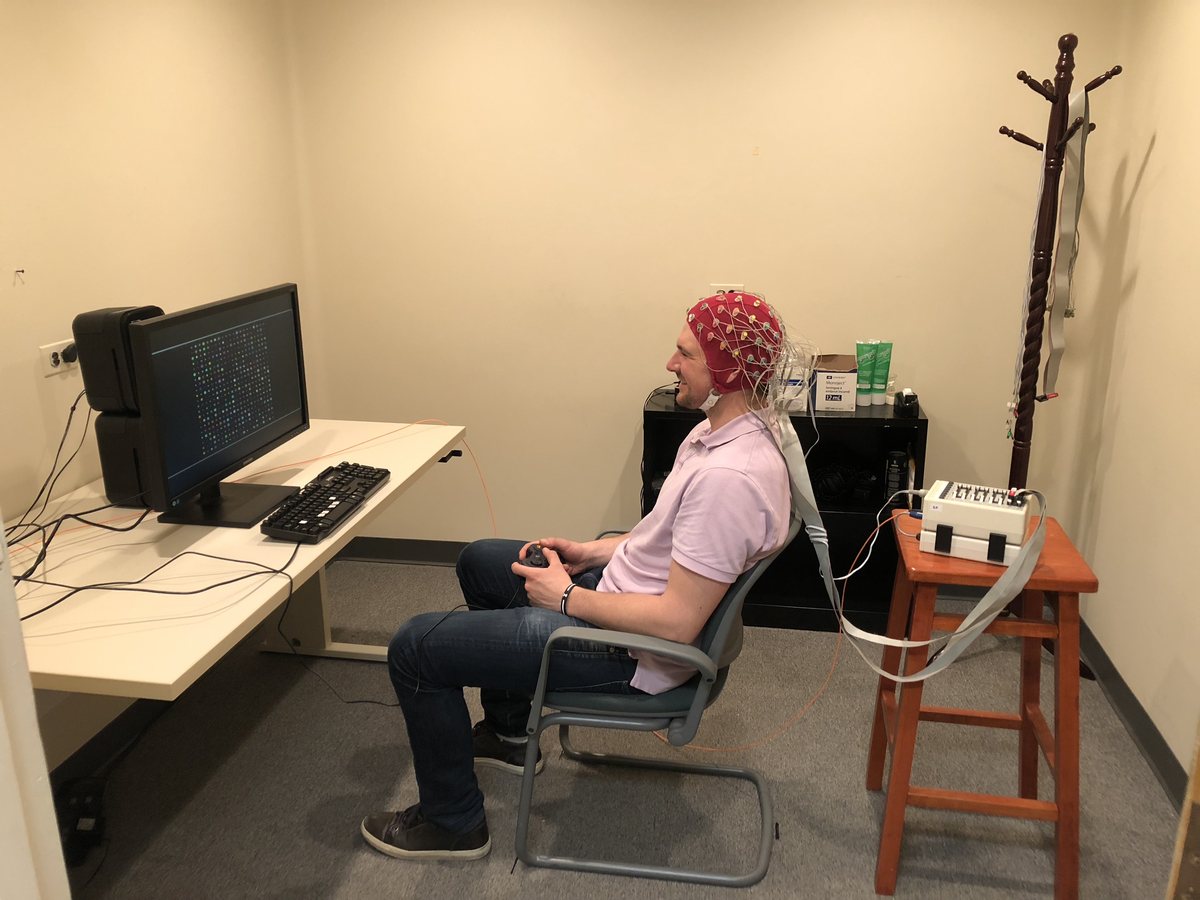
A six-month experiment suggests that sustained practice with fast-paced action video games may be linked to measurable changes in visual attention and resting brain activity. The study, published in the International Journal of Psychophysiology in 2026, followed 49 university students with little substantial prior gaming experience through 120 hours of training.
The researchers were interested in a narrower question than the familiar claim that games “make you smarter.” They focused on visual attention: the ability to select relevant information, resist distraction and distribute attention across a broader visual field. Those capacities are heavily taxed by fast games, where important cues compete with constant movement and visual clutter.
Participants completed two attention measures before and after the training period. One was the d2 Test of Attention, a task that requires people to identify targets among highly similar distractors while maintaining speed and accuracy. The other was an Attention Breadth task designed to assess how effectively attention can be spread across visual space.
Performance improved on both measures after the six-month intervention. That pattern is consistent with stronger selective and distributed attention, although it should not be translated into a claim about global intelligence. The study did not test whether participants became better at school, work, memory in general or unrelated reasoning tasks.
The experiment also included resting-state EEG. Instead of looking only at task scores, the researchers examined electrical activity in the brain when participants were not actively playing. Their analysis included local spectral measures as well as indices of large-scale functional organization.
After training, the team reported changes involving alpha activity and network organization. Some EEG features were associated with the size of individual attention gains. In other words, the behavioral improvement was accompanied by measurable differences in brain activity that tracked, to a degree, how much participants improved.
That makes the study more informative than a simple before-and-after reaction-time test. It offers evidence at two levels: performance and neurophysiology. The authors interpret the pattern as being compatible with experience-dependent plasticity in systems involved in information processing and attention.
There is, however, a major limitation. The study used a single-group longitudinal design and did not include a control group. All 49 participants received the gaming intervention. Without a comparable group that spent six months doing something else — or no specific training at all — the researchers cannot conclusively attribute every change to gaming. Practice effects from repeated testing, familiarity with the laboratory and other changes over six months remain possible explanations for part of the improvement. The paper explicitly acknowledges that constraint.
There is also a correction worth making to viral versions of the story. The paper does not establish that Dota 2 or Counter-Strike 2 were the games used in the six-month intervention. It discusses the broader category of action video games and describes first-person shooters as a common example of games with high perceptual demands. That is not the same as demonstrating a CS2-specific effect, and it provides even less basis for naming a particular MOBA.
Separate research has come closer to recognizable esports titles. A small 2021 study trained FPS-naive young adults with Counter-Strike: Global Offensive for three weeks and reported improvements on some cognitive measures, especially under an adaptive training protocol. A 2018 experiment using League of Legends also reported short-term changes in visual selective attention and EEG after a gaming session. Those studies are useful context, but they differ substantially from the new six-month project.
The broader literature remains contested. One influential meta-analysis reported small-to-moderate benefits of action-game play for top-down attention and spatial cognition. Another meta-analysis found no persuasive evidence that video-game training causes broad improvements in overall cognitive ability. That disagreement is a reminder that near-transfer gains in tasks resembling the training environment are easier to demonstrate than sweeping improvements across daily life.
The best reading of the new study is therefore specific rather than sensational: among 49 relatively inexperienced student gamers, 120 hours of action-game training over six months coincided with better performance on two visual-attention measures and with changes in resting EEG organization. The result strengthens the case that demanding digital environments can shape attention-related systems, while leaving open how much of the effect is causal, how durable it is and how far it transfers beyond the laboratory.
One more viral claim does not survive the fact-check: the study did not test whether losing a match is itself beneficial. Wins and losses were not isolated as an experimental variable, so “even defeats are good for your brain” should not be presented as a finding.
78