Researchers weave a working touchscreen into a shirt sleeve
Scientists at the National University of Singapore have built a touchscreen woven directly into a garment that displays images, plays video and responds to touch, and it survived 50 machine washes with nearly unchanged performance.
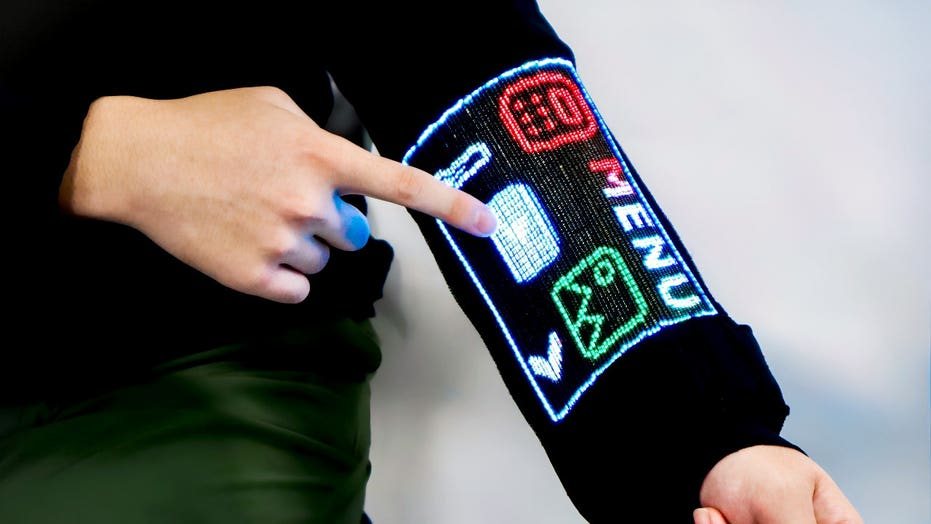
Researchers at the National University of Singapore have developed what they describe as the world's first touchscreen woven directly into a garment, a prototype that could eventually turn a shirt sleeve into a display you can tap with your finger. The team reports that the fabric displays images, plays videos and responds to touch, and that it kept nearly the same performance after 50 machine-washing cycles. The findings were published in the journal Nature.
The technology relies on specialized electronic fibers. Each fiber contains tiny light-emitting diodes, or LEDs, along with an electronic layer that senses touch. When someone presses the fabric, the sensing layer identifies the location and activates the corresponding pixels, so the garment responds much like a conventional touchscreen. The system can also register multiple touches at once, allowing more than one area of the display to react simultaneously.
To build the prototype, the researchers threaded 54 specialized fibers into the forearm of a sleeve. Each fiber carries 96 LEDs, producing a display of 96 by 54 pixels that measures roughly 6.6 by 4.1 inches. The team also developed a manufacturing method that connects more than 5,000 microchips through over 20,000 electrical connections. The resulting electronic fibers are about one millimeter thick and 10 meters long, which allows the fabric to bend with the wearer's movements while keeping the display working. Each fiber has its own control channel, so a fault in one fiber does not automatically shut down the others.
The project was led by Assistant Professor Tural Khudiyev at NUS's College of Design and Engineering. The prototype already handles several functions people associate with smartphones. It can display a photo gallery and run a calculator, and it can act as a digital compass. A sensor positioned under the arm shows body temperature readings. Video playback is possible, with the screen refreshing at 30 frames per second and 8-bit color depth; that rate drops to 25 frames per second when synchronized audio is playing.
The researchers also built a microphone and speaker into the garment using additional electronic fibers. The sleeve can receive images over Bluetooth, respond to voice commands and adjust its brightness automatically based on surrounding light. Its interface rotates when the wearer changes orientation. The researchers have, however, demonstrated only specific wireless functions, such as receiving images over Bluetooth. They have not shown the sleeve replacing a smartphone screen or displaying a phone's full set of notifications. The 96-by-54-pixel resolution also means the display is far from high-definition.
Durability has long been one of the main obstacles for electronic clothing, since garments are stretched, worn daily and put through the washing machine. According to NUS, the display's brightness and touch response remained nearly unchanged after 50 detergent washes in a typical washing machine. Independent reporting on the work indicates the fibers were placed in a laundry bag and washed on gentle cycles. The technology also held up through 1,000 bending cycles around a five-millimeter radius.
Those results are encouraging, but they were obtained under specific research conditions and do not guarantee that a finished consumer shirt containing all its electronics would survive years of everyday laundry. The researchers also reported that the fabric remained breathable, with breathability comparable to familiar materials including cotton and polyester, and that the display stayed within established safety limits for skin contact. Those findings move the work closer to practical interactive clothing, though the team's testing still has to go further before such garments could be worn daily.
The NUS prototype follows other experiments with flexible displays. Motorola previously demonstrated a bendable phone screen that wraps around a wrist. The NUS approach differs by building electronic functions directly into the fibers of the clothing itself, which opens the possibility of garments that could eventually show information and interact directly with other electronic devices.
5