Trump and Thune clash over Senate August recess in SAVE Act standoff
President Trump is pressing the Senate to stay in session through August to pass the SAVE America Act, but Majority Leader John Thune says the votes are not there.
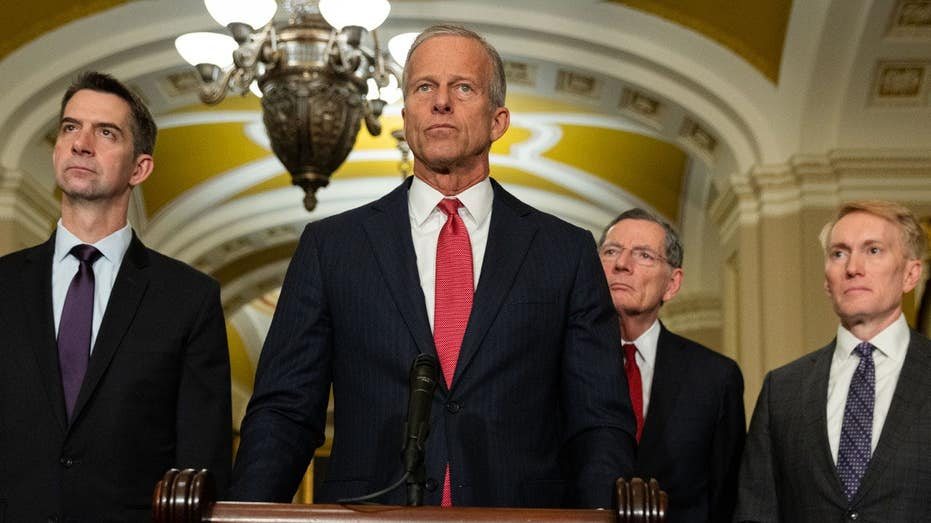
President Trump and Senate Majority Leader John Thune are on a collision course over the Senate’s August recess, as the president presses Republican lawmakers to stay in Washington until they pass the SAVE America Act, a bill that would require proof of citizenship to vote.
Trump has made clear he wants the Senate to keep working through its traditional summer break. «I think there’s nothing more important than they pass the SAVE America Act. I think they should stay,» Trump said. «They do what they want. But I think they should stay.»
Thune, Republican of South Dakota, has rejected that demand. «I don’t think having a Congress sitting around here for the month of August and quorum calls or having to vote on Democrat amendments is probably a good use of anybody's time,» Thune said.
The standoff reflects a deeper math problem for the SAVE America Act. The Senate has already defeated two attempts to adopt the measure, and Thune has told the president that the votes are not there. The majority leader suggested Trump and his team could change that by talking directly with skeptical Republican senators. «We have in the past suggested to he and his team to come up here and visit with some of my Republican colleagues,» Thune said. «Now if he can change the facts and start moving some of those senators who are noes into yesses, then we have a different conversation. But that's just the reality.»
Sen. John Kennedy, a Louisiana Republican, offered a slightly more optimistic view. «I know Sen. Thune says the votes aren't there. I'm not saying he's wrong. I'm just saying people change their mind sometimes,» Kennedy said.
Even so, there is no sign that a new vote on the bill will happen before the recess unless something shifts quickly. Conservative allies of Trump, including Sens. Mike Lee of Utah, Ted Cruz of Texas, Roger Marshall of Kansas and Rick Scott of Florida, have argued that the Senate should not leave town until the measure passes. Scott has framed the issue in simple terms: Americans work five days a week, so the Senate should be able to do the same.
The procedural fight could begin as early as the end of this week, when the Senate is expected to take its final votes before breaking for the August recess. Those votes could include the confirmation of Todd Blanche as attorney general and a Russia sanctions bill named after Sen. Lindsey Graham of South Carolina. Once the Senate has finished that work, the question becomes how to handle the constitutionally required mechanics of going out of session.
Under Article I, Section 6 of the Constitution, neither chamber can adjourn for more than three days without the consent of the other. The House, however, has already left Washington and is not available to approve an adjournment resolution. That means the Senate must rely on a series of brief pro forma sessions, typically held every three days, to satisfy the constitutional requirement. In recent years, the Senate has generally not voted on an adjournment resolution before leaving town; instead, leaders have used unanimous consent to set up the pro forma schedule.
Thune or one of his deputies would normally ask for unanimous consent to lock in that schedule of pro forma sessions. Any single senator can object. The Senate needs the buy-in of all 100 senators to approve the recess schedule.
An objection alone would not stop the Senate from leaving or force a debate on the SAVE America Act. But it could create a path to a vote that functions, in effect, as a standoff over going on recess. A senator who wants to make a point could demand a vote on adjourning Friday and meeting Saturday. Motions to adjourn are not debatable on the floor, but they are amendable, giving senators a narrow opening to force the chamber to confront the schedule issue.
If the Senate did meet on a Saturday, Thune could quickly move to adjourn again. One of the SAVE Act proponents might not even be recognized to speak. If Thune allows it, though, that senator could take the floor and hold it for as long as they want. That would not be a filibuster, because the goal is to start a debate, not to stop legislation. Even so, the strongest advocates of the SAVE America Act have not yet used that prerogative.
The dispute over the August recess highlights the divide among Republicans over the SAVE America Act. Trump wants a legislative win on the bill, while Thune sees little value in forcing the chamber to stay in session when the votes are not there. The result is a standoff that could play out in procedural maneuvers as the Senate tries to wrap up its summer work.