Obama's Brother-in-Law Rejects Racism Claims Against College Sports Bill
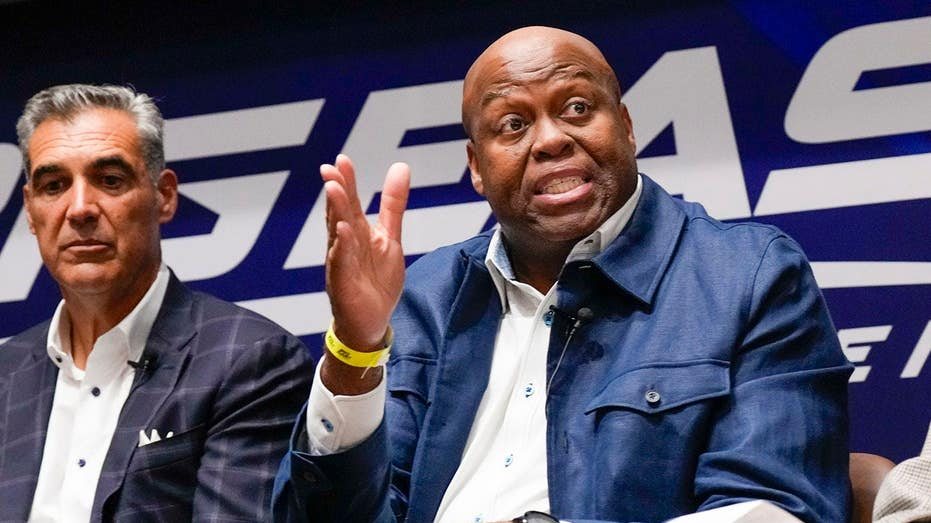
Craig Robinson, executive director of the National Association of Basketball Coaches and Barack Obama's brother-in-law, pushed back against claims that the Protect College Sports Act is racist, arguing the bill would help student-athletes get college degrees.
A sweeping Senate bill to overhaul college sports is facing accusations of racism from civil rights groups and some Democratic lawmakers, but supporters of the legislation — including former President Barack Obama's brother-in-law — are forcefully rejecting those claims as the measure moves toward a final vote.
The Protect College Sports Act, sponsored by Sens. Ted Cruz, R-Texas, and Maria Cantwell, D-Wash., has cleared two key procedural hurdles in the Senate and is headed for a final vote in the coming week. The bill would impose new restrictions on the transfer portal, establish a uniform five-year eligibility framework, create recruiting and tampering guardrails, set a federal standard for name, image and likeness rules, and cap revenue sharing.
Opponents, including NAACP President Derrick Johnson, the Congressional Black Caucus and Sen. Chris Murphy, D-Conn., argue the legislation would disproportionately harm Black student-athletes by stripping away the decision-making power they gained through NIL deals and returning it to predominantly White coaches and college administrators.
«It's a civil rights issue, that's the reason the NAACP is strongly opposing this bill, because they see it as a civil rights issue,» Murphy said. «The athletes who will be most affected by this bill are largely Black athletes, and the people who will be helped by this bill are largely White coaches and White college sports executives.»
Craig Robinson, executive director of the National Association of Basketball Coaches and Obama's brother-in-law, dismissed that framing. «Well, you know everybody is entitled to their interpretation of what's going on,» Robinson said. «I would disagree with that, and I would point out that if we don't fix this system, the same student-athletes they're talking about are not going to be college educated, because you cannot get educated by transferring to four or five different schools. You can't get a college degree doing that, so that's what I would say.»
Robinson was among several former coaches who traveled to Washington, D.C., this week to promote and support the bill. Craig Bohl, executive director of the American Football Coaches Association, called the assertion that the legislation carries racist undertones «the farthest thing from the truth.»
«You know, one of the things that has been good for me, you know, working 43 years, coaches care deeply about all our players,» Bohl said. «And while I appreciate their convictions on it, it's a misguided statement.»
Bohl added that the bill is about expanding opportunity. «What we're looking at is opportunities for all. We want players to have an opportunity for compensation,» he said. «We want players to be able to have the ability to transfer. We also are looking for some stability with eligibility. We don't need NFL players coming back playing in our game.»
The Congressional Black Caucus has opposed the bill for months and signaled its members would not support the legislation following the Supreme Court's decision on the Voting Rights Act earlier this year. Sen. Eric Schmitt, R-Mo., one of the bill's co-leads, acknowledged that some of those concerns extend beyond the scope of the legislation.
«Honestly, some of those concerns initially were over redistricting, and, you know, I'm not solving that problem with this bill,» Schmitt said. «We're just trying to address the chaos that exists right now in college athletics, where 27-year-olds are playing against 17-year-olds, unlimited transfers, graduation rates are plummeting.»
The bill has drawn bipartisan support even as it faces opposition from the SEC and Big Ten, which have raised concerns about how the new rules would affect their conferences. Cruz and Cantwell have refused to bend to those concerns in the revised legislation, keeping the measure on track for a final Senate vote.
At the center of the debate is a fundamental disagreement over what the bill would actually do for student-athletes. Supporters contend that without uniform rules, players will continue to bounce between schools without earning degrees, while opponents insist the legislation would roll back hard-won autonomy for the athletes who generate billions of dollars for their institutions.
The outcome of the vote will determine whether Congress steps into a rapidly changing college sports landscape that has been reshaped in recent years by NIL deals and the transfer portal, with schools, athletes and coaches all watching closely.