Iran reaffirms support for Hamas as Trump pushes Gaza disarmament plan
Iranian President Masoud Pezeshkian has congratulated Hamas's newly elected political leader Khalil al-Hayya and pledged Tehran's continued support, complicating the Trump administration's push for a Gaza disarmament agreement.
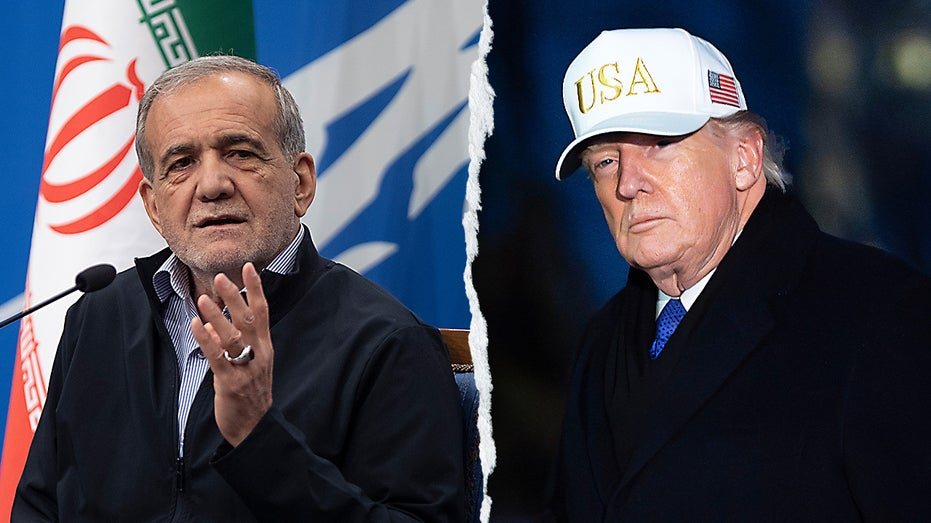
Iranian President Masoud Pezeshkian has reaffirmed Tehran's backing for Hamas, congratulating the group's newly elected political chief and pledging continued support for the Palestinian cause just as the Trump administration promotes a plan to disarm the group and remove it from power in Gaza.
Hamas said Monday that Pezeshkian called Khalil al-Hayya after his election as head of the group's political bureau. According to the group's Arabic-language statement, Pezeshkian told al-Hayya: «We are with you, and we support you in every action you take, despite the attacks we are facing.»
The reported call highlights a central contradiction in President Donald Trump's Gaza initiative. While the White House presents its roadmap as a landmark agreement that would strip Hamas of its weapons and end its rule over the enclave, the group's longtime financial and military patron was publicly reaffirming its support at the same moment.
Trump announced the plan as a «HISTORIC agreement for the COMPLETE DISARMAMENT of Hamas and all other armed groups,» describing it as a breakthrough after nearly three years of war.
At the center of the effort is the Board of Peace, a body chaired by Trump and run by an executive team that includes Secretary of State Marco Rubio, special envoy Steve Witkoff, Jared Kushner and former British Prime Minister Tony Blair. The White House says the board will oversee Gaza's transition, mobilize reconstruction funding and hold the parties accountable.
Yet the same day the Iranian call was reported, board officials met with Israeli Prime Minister Benjamin Netanyahu and urged Israel to halt attacks in Gaza. According to an Israeli political official, Israel rejected the board's two central demands: it will not withdraw from its current line in the Gaza Strip and will continue to thwart threats to civilians and soldiers.
A Board of Peace official declined to discuss the meeting but said the body remains focused on implementation. «We have provided a pragmatic path forward to transform Gaza by removing Hamas from power and seeing it hand over its weapons,» the official said. «These steps would undoubtedly allow for the improvement of life in Gaza and enhancement of security in Israel. We remain determined to advance these objectives.»
The proposed roadmap has 15 points and calls for Hamas to transfer civilian government and security responsibilities to a Palestinian technocratic body, the National Committee for the Administration of Gaza. Hamas-run police would surrender their weapons to the committee, while heavy weapons, military production sites, weapons depots and tunnels would be addressed later through a phased decommissioning process linked to an Israeli withdrawal.
The intended endpoint is that only a new Palestinian authority would control weapons in Gaza. But the plan leaves open who enforces the process, what counts as compliance and which side must move first.
Hamas has so far agreed only to a phased and conditional arrangement involving the storage of weapons after Israel stops attacks, withdraws forces and allows more aid into Gaza. The group has avoided using the word «disarmament» and insists its weapons would remain under Palestinian control rather than being handed to Israel or an international force.
The status of Hamas's arsenal is widely seen as the central obstacle to rebuilding Gaza. Trump has tied reconstruction to the group laying down its weapons, while the Board of Peace has reportedly secured around $7 billion in pledges by February, a fraction of the estimated $70 billion needed to rebuild the devastated territory.
Moumen al-Natour, a Palestinian lawyer from Gaza and co-founder of the anti-Hamas «We Want to Live» movement, said civilians desperately want the agreement to succeed but do not trust Hamas to give up power. «Civilian people inside Gaza Strip… want safety, want to stop this war, want a new government, want to be alive,» he said. Al-Natour, who was previously imprisoned by Hamas, warned that the group would use delays and violations to remain embedded in Gaza. «I can't trust Hamas because I know Hamas,» he said.