
USS George Washington captain says morale is high for new Mideast mission
The aircraft carrier USS George Washington has arrived in the Arabian Sea near the Strait of Hormuz, replacing the USS Abraham Lincoln. The ship's captain and strike group commander report high morale among the 5,000 sailors as they begin operations under US Central Command.
The aircraft carrier USS George Washington has arrived in the Arabian Sea near the Strait of Hormuz, placing a fresh American naval force within striking distance of Iran as the region braces for a prolonged US military presence. The Nimitz-class carrier, designated CVN 73, has replaced the USS Abraham Lincoln and now serves as the flagship of Carrier Strike Group 5, bringing roughly 5,000 sailors and nine operational squadrons of advanced strike fighters, electronic attack planes, and helicopters to the mission.
Capt. Nicholas DeLeo, the ship's commanding officer, said morale among the crew remains high as they begin their new assignment. «Morale aboard USS George Washington remains high among our sailors,» DeLeo said. «I see this as I walk the deck plates, seeing them take pride in their work — whether conducting flight operations, maintaining our systems or supporting one another on the ship. The dedication and teamwork I see across the ship is outstanding, and that spirit keeps us ready and resilient.»
The carrier is accompanied by several warships, including the guided missile cruiser USS Robert Smalls and the guided missile destroyer USS Shoup. Rear Adm. Jeff Heames, commander of Carrier Strike Group Five, said the teams are prepared for sustained operations. «Our Sailors understand the importance of the mission and continue to execute with precision and professionalism every day,» Heames said.
With the carrier group now operating in the Middle East, it falls under US Central Command. Retired Gen. Joseph Votel, the command's former commander, said the arrival of the George Washington demonstrates the importance of maintaining credible military capability in the region. «We're going to have to be prepared, because this is probably going to take some time, to continue to bring forces into the region, we want them to be at a high level of readiness,» Votel said.
Flight operations are continuing around the clock. Aircraft based on board include F/A-18E/F Super Hornet multirole strike fighters, F-35C Lightning II fifth-generation stealth fighters, EA-18G Growler electronic warfare aircraft, and E-2D Advanced Hawkeye airborne early warning and control planes. The ship also carries MH-60S and MH-60R Seahawk helicopters for anti-submarine warfare and search-and-rescue missions.
This past week, the carrier marked a historic milestone when Navy Lt. Steven Frazier, a pilot from Strike Fighter Squadron 147, made the 200,000th trap landing on the ship in an F-35C Lightning II. The stealth fighter was caught by the ship's steel arresting gear cable. «It's a good feeling for me to know that once I leave, I can come back to the aircraft carrier and trap,» Frazier said. The carrier can land one aircraft per minute and typically lands 70 aircraft a day.
Attention to mission is evident throughout the ship. Assistant Navigator Elizabeth Wayne said the crew remains focused on potential hazards and threats while navigating. «When we are in special evolution, when we are conducting flight operations, the most important thing is to ensure we are lock step with the airboss, the captain, the command duty officer underway, everybody needs to be on the same page to execute that safely,» Wayne said.
The Navy has also pushed back against Russian state media reports questioning the quality of food on board. Russia Today posted what are believed to be AI-generated photos of poor rations, but videos from the carrier show a wide variety of meal options, including a café below decks. Culinary Specialist 2nd Class Victoria Marc said 150 cooks work around the clock to prepare 15,000 meals a day. «Sailors have the opportunity to eat three meals a day, plus the night rations,» Marc said. «From the mess deck throughout the day, there's always something there where people feel fueled and ready for the fight.»
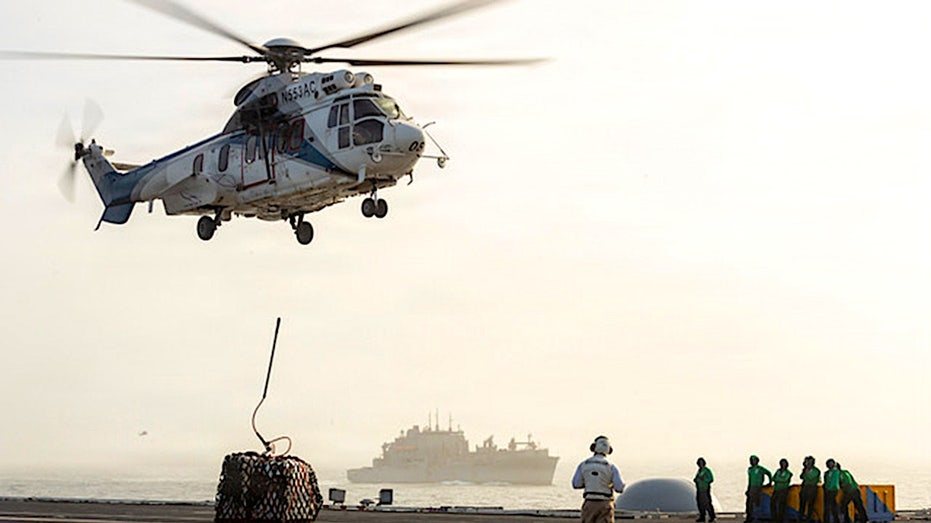
The carrier was replenished at sea twice in four days this past week, receiving an average of 2,000 pallets of supplies including fresh food and ammunition winched by helicopter from a nearby supply ship. Fuel for the carrier's aircraft is also transferred ship-to-ship. The carrier itself is nuclear-powered and will not need refueling at sea.
149