Betsy Ross and the First American Flag Take Center Stage as Nation Marks 250th Anniversary
As the United States celebrates its 250th birthday, historic sites in Philadelphia highlight Betsy Ross, the upholsterer traditionally credited with sewing the first American flag, and the story of how an ordinary woman contributed to a symbol of national unity.
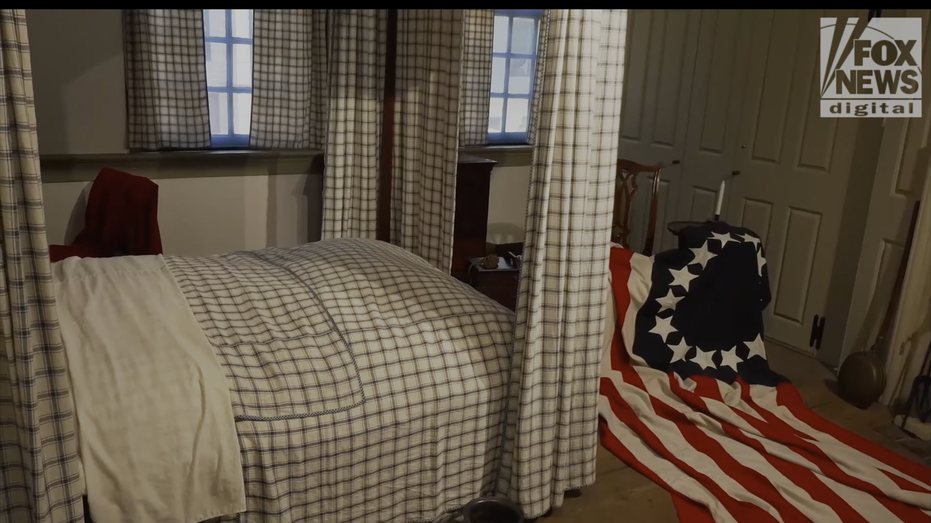
As the United States marks its 250th birthday, historic sites in Philadelphia are drawing attention to the people and places that shaped the nation’s earliest days — including one of its most enduring symbols: the American flag. While the Founding Fathers often dominate Revolutionary War history, the flag is traditionally linked to an ordinary woman working from her home in Philadelphia. Betsy Ross, a 24-year-old upholsterer, is widely credited with sewing what many believe was the first American flag in the summer of 1776, after reportedly being approached by a committee that included George Washington.
According to Lisa Acker Moulter, director of the Betsy Ross House, the historic site is helping visitors understand how that moment may have unfolded. Ross, she said, had never made a flag before but agreed to try. She suggested a key change to the design presented to her: the original sketch featured six-pointed stars, but Ross recommended five-pointed stars because they were easier to produce. She demonstrated a method she had learned as a child, folding cloth or paper and cutting a perfect five-pointed star with a single snip of her scissors.
Tradition holds that Ross worked in secrecy, sewing the flag by hand at night — likely in her home rather than her upholstery shop — and completing it in about a week. At the time, the colonies were still under British rule, making the creation of a national flag a potentially dangerous act. Moulter noted that making the flag would have been considered treason. If caught by the British or loyalists, Ross could have faced imprisonment or even execution.
The original design featured 13 stripes representing the colonies and 13 stars arranged in a circle to symbolize equality among them. The Continental Congress later adopted it as the nation’s first official flag on June 14, 1777. In its early years, the flag was used primarily on battlefields, military forts, and ships as a form of identification. It did not become a widespread symbol of national identity until the Civil War, when Americans began flying it over schools, government buildings, and private homes. Moulter explained that the flag has changed over time, becoming much more powerful and meaningful to people.
Over the decades, the flag evolved as new states joined the Union. The first major update came in 1795 with the addition of two stars for Vermont and Kentucky. The most recent change occurred in 1960 after Hawaii became the 50th state. From its disputed origins to its modern meaning, the American flag remains one of the country’s most powerful symbols — now taking center stage again as Philadelphia marks America’s 250th anniversary.
The story of Betsy Ross, Moulter said, reflects a broader truth about who contributed to America’s founding. It shows that ordinary people can contribute important things to the country. The nation was not founded solely by wealthy, powerful white men, the Founding Fathers. It was women, free and enslaved people, and new immigrants — all of them contributed to the founding of this nation, and that is represented through the first flag.
As part of the 250th anniversary celebrations, President Donald Trump spoke on the National Mall before a historically enormous fireworks show over the nation’s capital. He had one of the country’s first flags on stage with him during the Fourth of July speech, a flag dating from 1777. World leaders, including Russian President Vladimir Putin and Ukrainian President Volodymyr Zelensky, sent their best wishes to the United States, often linking their messages to their own policies or needs from the world’s most powerful nation.
The 250th birthday has also prompted reflections on the nation’s diversity. Nearly half of the U.S. soccer team, for example, is made up of immigrants, embodying the founders’ dreams of a nation built by people from around the world. The flag, once a practical tool for identification on battlefields and ships, has grown into a unifying emblem that continues to evolve with the country it represents.
108