BBC Defends Calling France Unrest «Mostly Peaceful» as Rioters Torch Cars and Clash With Police
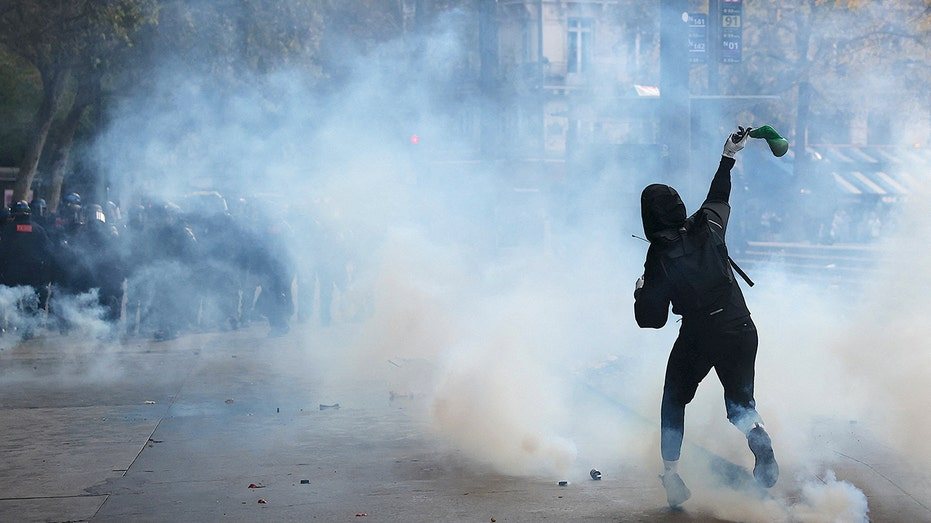
The BBC is standing by its characterization of France's nationwide protests as «mostly peaceful» even as its own footage showed masked rioters burning vehicles, looting businesses and battling police, with nearly 1,000 security personnel injured and thousands arrested.

The BBC is defending its coverage of France's nationwide unrest after one of its correspondents described the demonstrations as «mostly peaceful» while the network's own footage showed masked rioters setting cars ablaze, ransacking businesses and clashing with police.
The controversy centered on the broadcaster's «News at Ten» program, where host Jane Hill introduced a Sunday report by laying out the scale of the destruction. She said nearly a thousand police officers and firefighters had been injured across the country and that the Interior Ministry reported nearly 2,400 arrests.
Paris correspondent James Waterhouse then characterized the demonstrations as largely peaceful, noting that roughly half a million people had gathered in cities across France to protest rising living costs and deteriorating public services. «They were mostly peaceful, but as we saw in the capital, in the wings were those who wanted to take advantage of the disorder,» he said.
The broadcast showed rioters clashing with police, setting vehicles on fire and looting shops, including a wine store and an electric bicycle shop. Waterhouse acknowledged the destruction was being attributed to people exploiting the larger demonstrations. «The shops that have been hit have been completely gutted. Like this wine shop has been looted from top to bottom,» he said.
In a statement, a BBC spokesperson said its reporting accurately reflected the scale of the unrest while distinguishing between peaceful demonstrators and those responsible for the violence. «No one watching, reading or listening to BBC News coverage of the France protests and riots can be in any doubt as to what was happening – there is coverage of the fires, the looting and violence,» the spokesperson said. The spokesperson added that Waterhouse and the team in France provided broader context, noting that several hundred thousand people were on the streets in peaceful protest and that those carrying out the violence were a small fraction of that number.
French President Emmanuel Macron condemned the violence in a televised national address on Sunday, drawing a line between demonstrators with legitimate grievances and those responsible for the destruction. «Nothing justifies it, nothing explains it, nothing excuses it. Tonight, we all feel anger and shame,» Macron said.
The unrest prompted Interior Minister Laurent Nunez to offer his resignation on Monday, which Macron rejected. Nunez acknowledged that police had lost control in several major cities as the government weighed additional security measures. Prime Minister Sébastien Lecornu called for localized curfews to restore public order.
According to a Monday report by Agence France-Presse, more than 2,500 people had been arrested, nearly 1,000 security personnel injured and at least 3,000 businesses affected. Rioters also set fire to the historic Limoges Town Hall, built in 1883, causing extensive damage to the landmark.
The White House, asked for comment on the escalating violence in France, a key U.S. ally, pointed to two Truth Social posts from President Donald Trump addressing the unrest. In a Sunday post, Trump blamed immigration for the violence and urged French authorities to close the country's borders. «France is burning! The immigration of people from an entirely different world, people with hatred in their hearts, has shattered that once great country,» he said. He doubled down in a Monday morning post, writing, «The migrants have taken over France. They must CLOSE THE BORDERS, FAST!»
Waterhouse maintained that the violence was largely the work of people exploiting the demonstrations rather than those who had gathered to protest. «Few believe this was at the hands of the genuine protesters, but down to an opportunistic minority who came in and sought to rob and cause carnage,» he said.
4