
August 12 solar eclipse: what the U.S. will see and where totality falls
The United States will miss totality on Aug. 12, but parts of the North will see a partial eclipse while the Moon’s central shadow crosses the Arctic and Spain.
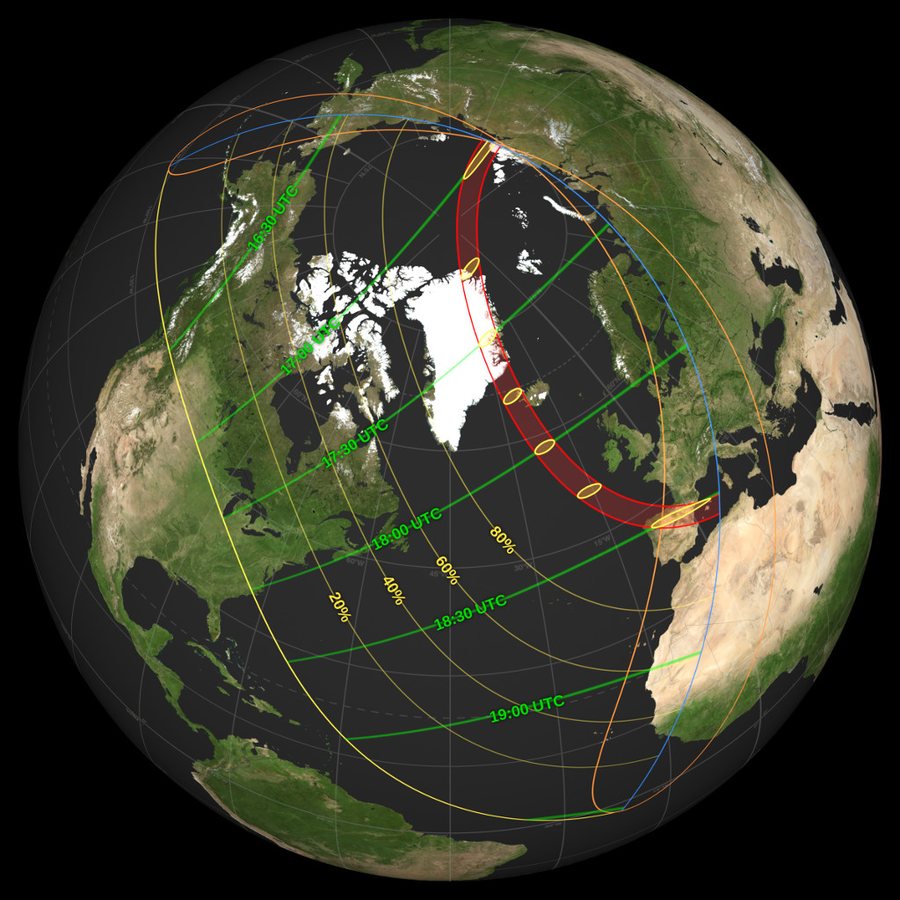
The next total solar eclipse arrives Wednesday, Aug. 12, 2026, but Americans will need to travel far beyond the continental United States to stand in the Moon’s central shadow. The path of totality runs across far northern Russia, Greenland, Iceland, the North Atlantic, Spain and a small corner of northeastern Portugal.
Parts of the northern United States will still see a partial eclipse. NASA’s city table puts the maximum solar coverage at about 28% in Anchorage, 16% in Boston, 9% in New York City and 4% in Washington, D.C. Fairbanks reaches about 37%, among the deeper examples NASA lists for the U.S.
Europe will get the more dramatic evening show. León, Zaragoza and Valencia in Spain are in the totality path, while central Madrid and Barcelona reach about 99% coverage without becoming fully total. London, Paris, Milan and Berlin will all see deep partial eclipses.
Eye safety does not depend on how much of the Sun is covered. During any partial phase, NASA says viewers need proper eclipse glasses or a safe handheld solar viewer; ordinary sunglasses are not sufficient. Cameras, binoculars and telescopes need purpose-built solar filters on the front of their optics. NASA also plans a live eclipse broadcast beginning at 1:15 p.m. EDT.
74