Planted Raises $31.8 Million to Build Solar Farms With Robots and Less Land
Planted, a startup that uses digital twins and robots to install solar panels on natural terrain, has raised $31.8 million to scale its land-efficient approach as data centers and utilities seek faster power.
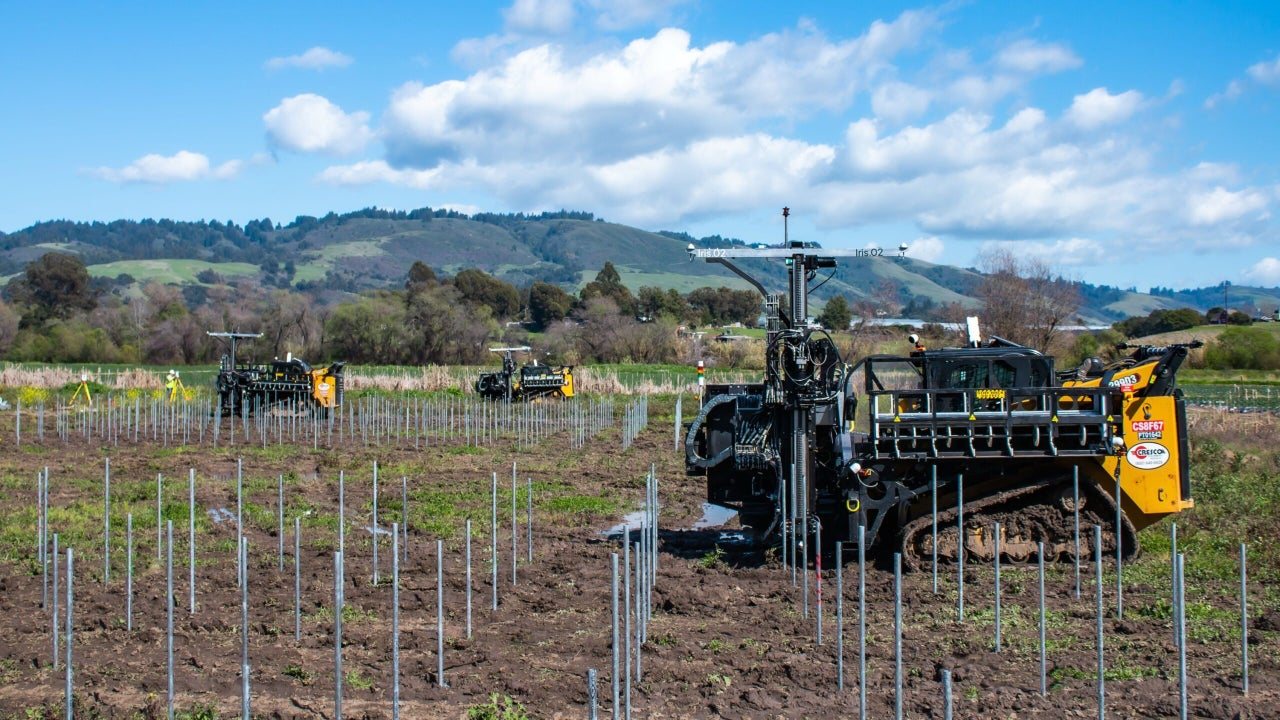
Planted, a startup that uses robots and digital modeling to build solar farms on natural terrain, has raised $31.8 million to scale its land-efficient installation technology. The funding round was led by Piva Capital and RA Capital Management Planetary Health, with participation from Google, Breakthrough Energy Ventures, Gigascale Capital, and Khosla Ventures.
The company's approach addresses a growing problem for utility-scale solar: land. When a project was planned in a St. Louis suburb, the county zoning board rejected the design because it took up too much space and sat too close to a neighboring subdivision. The developer turned to Planted, which used a digital twin and robots to redesign the project. The result was a solar farm that used 40% less land to produce the same amount of power, allowing it to move forward.
At a time when energy demand is surging and solar projects often face roadblocks and long delays, Planted's method aims to speed up deployment. The company's technology rethinks how solar projects are built. A typical solar farm uses long racks to hold rows of panels that track the sun, but that design requires flattening the land, adding time and expense, and leaving hilly areas unused. Planted instead uses a separate post for each panel, allowing the array to follow the natural contours of the site.
The process begins with software that builds a digital twin, a live virtual model of the site, to plan where each post should go. Robots then place each post precisely, pulling them from a compartment the startup compares to a giant toothpick dispenser. A custom bracket on top allows a solar panel to snap on like a Lego piece. The precision required would be difficult to achieve manually.
«Placing thousands of foundations precisely is exactly the kind of work that's slow and error prone for crews,» said Eric Brown, Planted's CEO. By following the bumps and hills of the terrain, Planted can pack in more solar panels and build in places conventional designs could not use. «We build on slopes up to 27% without grading, so we can use more of each parcel, including the acres a conventional design writes off, which means smaller total footprints,» Brown said.
The approach also makes permitting easier. Because it can cut the amount of land needed in half or more, it is easier to find sites. «You can have an easier time going and getting 2,000 acres instead of 4,000 or 5,000 acres,» Brown said. The density makes some projects feasible. One developer planning solar and batteries for a new data center in Washington state realized the layout would not meet a county requirement for data centers to bring their own power on site. Planted redesigned the project, enabling 2.5 times more energy production so the solar plant would pencil out.
In another project, a developer in the Southeast planned to sell power to a hyperscaler, but a new wetlands designation meant more than half the land could no longer be used. Planted rolled out a new design that generated enough power on the remaining buildable land. By building directly on the existing landscape instead of grading it flat, Planted can ease environmental approvals. Vegetation stays in place, stormwater flows as before, and the panels sit lower, reducing visual impact.
Robotic installation is also fast. One recent project went from the start of construction to mechanical completion in about three months. But the impact on site viability and permitting is even more important, in some cases shrinking a process that can take years to months.
With the new funding, Planted will expand its fleet of robots, which are already fully booked through next year. The newest model, called Sage, doubles the productivity of the current generation. Brown said there is no shortage of demand from hyperscalers and other customers. The company expects to build 100 megawatts of solar in 2026, with a project pipeline of more than 20 gigawatts, enough to power three-quarters of a million homes.
In many cases, data centers are building behind-the-meter power on-site. Solar increasingly looks like the best option, not only because it is clean and can avoid the opposition that gas plants face, but because it can be built quickly. «I think in the last year or so there's been a realization that solar and storage can be built much much faster than anything else,» Brown said. «The combined cost profile is either in line or maybe even cheaper than grid plus gas.»
Solar power is already the dominant new source of energy in the U.S. In the first half of 2026, solar and battery storage made up 70% of new capacity added to the grid. Planted's technology could help that trend continue by making more projects viable on less land.