Joseph Gordon-Levitt Calls for Shutdown of AI Companies at TIME100 AI Impact Dinner
At the third annual TIME100 AI Impact Dinner in San Francisco, actor Joseph Gordon-Levitt argued that AI companies should be shut down by the government until their products are proven safe, while other honorees highlighted AI's potential to preserve endangered languages and improve hospital care.
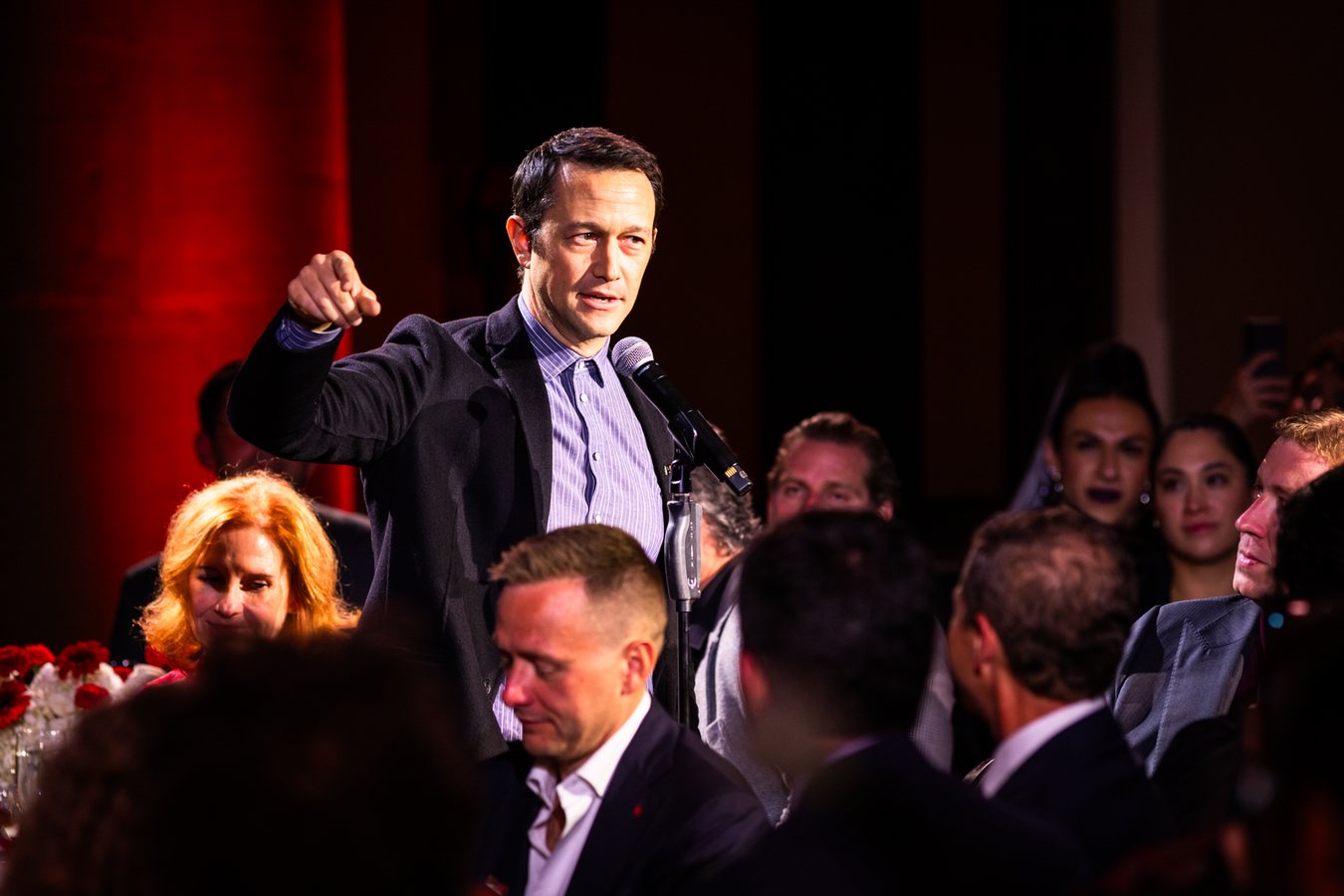
Actor Joseph Gordon-Levitt used a toast at the third annual TIME100 AI Impact Dinner in San Francisco on Monday to call for the U.S. government to shut down major artificial intelligence companies until they can prove their products are safe. Speaking to an audience of honorees and guests at the Asian Art Museum, the Inception star said today's AI makers have lost control of their creations and must be regulated to prevent potential harm.
«Why are cars safe to drive? Why are houses safe to live in? It's because car companies and construction companies... they have to follow laws. And if they don't, then the law can come and shut those companies down,» Gordon-Levitt said. «So let's just be clear here: today's AI companies are operating in such a way that the law should be shutting them down.» His remarks drew loud clapping, whoops, and cheers from many in the crowd, which had gathered to celebrate the 2026 TIME100 AI list of the year's most influential people in the field.
Gordon-Levitt, one of the 100 leaders, innovators, storytellers, and activists named to the list, argued that AI company leaders and employees have publicly admitted their products are dangerous and cannot be controlled. He appeared to reference July's cyberattack by a «swarm» of rogue OpenAI agents as well as multiple recent statements from current and former Anthropic employees warning that AI could end all human life. «To me, that's pretty obvious that's the time the law should step in,» he said.
The actor went on to criticize U.S. politicians as «timid» for failing to act, alleging they may be taking money from «some of the guys in this room.» According to the New York Times, AI companies, allies, and executives spent at least $83 million on federal elections in 2025 and are set to spend even more this year. Gordon-Levitt urged Americans not to vote in November's midterms for any politician who stands for «anything less than strong regulation, now.»
Other toasts at the event struck a different tone, highlighting both the positive potential of AI and its dangers. Danielle Boyer, a 25-year-old Indigenous American inventor and activist, described how she is using AI to help preserve her people's endangered language. «My grandmother once told me that no decision belongs only to the moment in which we make it,» Boyer said. «Long after we're gone, someone we will never meet may still be living with what we chose to do today.»
Boyer explained her community's «seven generations» principle: draw inspiration and support from the seven generations before you, and act for the benefit of the seven generations after you. Those teachings inspired her to start building robots to teach Anishinaabemowin, the native language of the Great Lakes region's Anishinaabe people that was almost wiped out by U.S. residential schools and is now estimated to have fewer than 1,000 fluent speakers. «The decisions we make about artificial intelligence today will outlive every person in this room. That's crazy, right?» Boyer said. «So let's build things the right way. Let's build so that seven generations from now, our descendants can look back at this moment and thank us, rather than have to recover from us.»
The final toast came from Suchi Saria, a Johns Hopkins computer scientist and founder of Bayesian Health, who has spent years studying how routinely collected clinical data and vital signs could help spot an ailing patient before human clinicians notice the problem. «Hospitalized patients can quietly become critically ill from respiratory failure, internal bleeding, kidney failure, dangerous heart rhythms, and many other causes,» she said. Saria saw that firsthand in 2017, when her family in India called to tell her that her nephew was critically ill with sepsis. «We knew the signals were there. We had published the science,» she told the guests. «And yet, when it mattered to my own family, there was nothing I could offer them. The science had not yet become a system. My nephew died within a few days.»
Saria's voice audibly cracked, and there was a moment of silence. When she spoke again, she described Bayesian Health's progress on using AI to catch sepsis early, resulting in a 20 percent drop in mortality, the company claims, when clinicians act promptly on the system's warnings. «The real breakthrough is not prediction. It is not even discovery,» she said. «It is turning insight into action early enough to change what happens to a patient.» The TIME100 Impact Dinner: Leaders Shaping the Future of AI was presented by Deloitte,, and Cognizant.