Hackaday Europe 2026: Developer Makes Bare-Metal Programming Accessible With Minimacy Platform
At Hackaday Europe 2026, software developer Sylvain Huet presented the Minimacy project, a transparent bare-metal computing platform built on the Raspberry Pi RP2350 that aims to eliminate operating system dependencies and restore developer understanding of the full software stack.
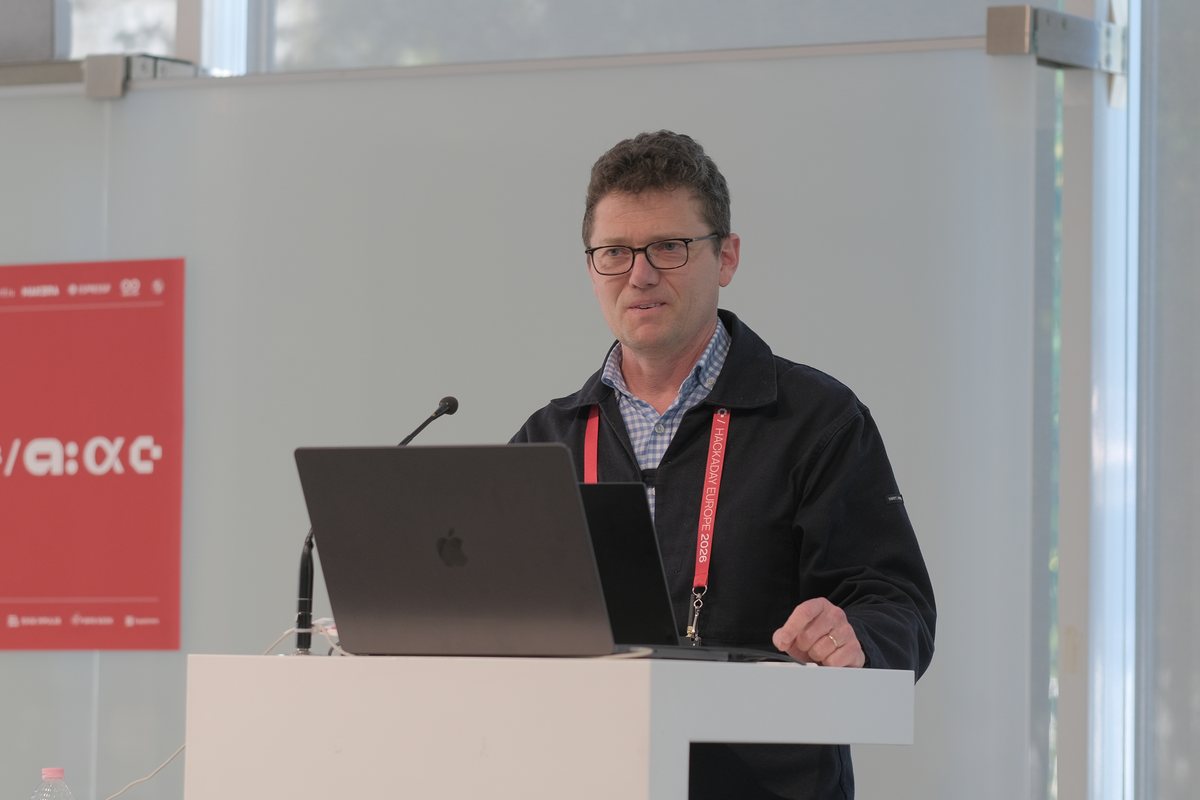
Software developer Sylvain Huet took the stage at Hackaday Europe 2026 to argue that modern computing has buried itself under layers of unnecessary abstraction, and to present a practical alternative. His Minimacy project, a transparent bare-metal platform built on the Raspberry Pi RP2350, is designed to let a single developer understand an entire system from top to bottom without relying on operating systems, bloated dependencies, or opaque third-party libraries.
Bare-metal programming means writing software that runs directly on hardware with no operating system or abstraction layers in between. The approach gives programs the most direct possible access to peripherals and memory, but it sacrifices the protection and ancillary features that an OS normally provides. Huet's talk, titled «Bare Metal Made Easy,» traced his own computing journey back to 1982, when he acquired a Thomson TO7 with just 8 kilobytes of user RAM and a 6809 CPU. «It was easy to understand everything about your computer,» he recalled. «There was almost no hidden side in this computer.»
That simplicity did not last. Over the following decades, Huet worked on projects including a Metaverse-like product called Second World and the Wi-Fi-enabled Nabaztag rabbit, often operating close to the hardware to maximize performance. He contrasted that era with the present day, pointing to the 2024 CrowdStrike outage as a cautionary example. Airport flight schedule displays that once ran on purpose-built hardware are now commonly flat-screen monitors powered by full Windows computers. While convenient to build, that complexity carries real costs, as the outage demonstrated when a single faulty update disrupted operations worldwide.
Huet showed that such a display can instead be built with a Raspberry Pi running a bare-metal program with no operating system at all. Because the software is coded to do one job from the ground up, it is far less likely to fail due to an outside update or the collapse of an obscure dependency that no one on the development team knew was included. The modern operating system, he argued, is perhaps the biggest black box of all, and removing it provides far more transparency about what is happening under the hood.
At the center of his approach is what he calls a «new minimalism,» guided by the principle that «all you need to understand should fit in your single brain.» It is not merely about working at the bare-metal level, but about creating systems where one developer genuinely comprehends the entire project. Huet acknowledged limits to how large a project any single person can fully understand, but said the principle remains useful for certain applications.
He also addressed how developers use outside libraries, describing a «low-level paradox» in which the more sophisticated a task becomes, the more we rely on black boxes to handle parts of the work. That speeds development but quickly adds thousands of lines of code and allows developers to avoid understanding what is actually happening under the hood.
The Minimacy Machine is intended as a platform focused on transparency at every level. It runs on the Raspberry Pi RP2350 at 150 MHz and includes Ethernet connectivity, an OLED display, an SD card reader, and a real-time clock. Huet created the Minimacy language to enable development with fewer dependencies, black boxes, and operating systems while maximizing the capacity for understanding. The language is concise, linear, and safe, with strong static typechecking and type inference. It works through the Minimacy virtual machine, which combines an instant compiler and a virtual processor that can run the code.
The project is 100 percent open source and written in less than 900 kilobytes of C, both of which support the goal of keeping the whole stack within a developer's ability to understand it. Huet demonstrated the system's lightness by running a Minimacy game off a floppy disk on a modern UEFI laptop. The idea is that a Minimacy VM could run on a variety of hardware, allowing near-bare-metal access for Minimacy code while maintaining some portability across systems.
Huet's broader message was not that bare metal is right for everything. The vast majority of users will continue to rely on operating systems for applications where they are necessary and useful. But in an age of ever-deepening abstraction, he argued, it is sometimes worth remembering that simplicity still has a place, and that understanding the whole stack is not an impossible ideal.