Dortmund teenagers stun Arsenal 3-2 at the Emirates
Borussia Dortmund beat the reigning Premier League champions in a five-goal Emirates Cup match, with all three German-club goals scored by players aged 18 or 19.
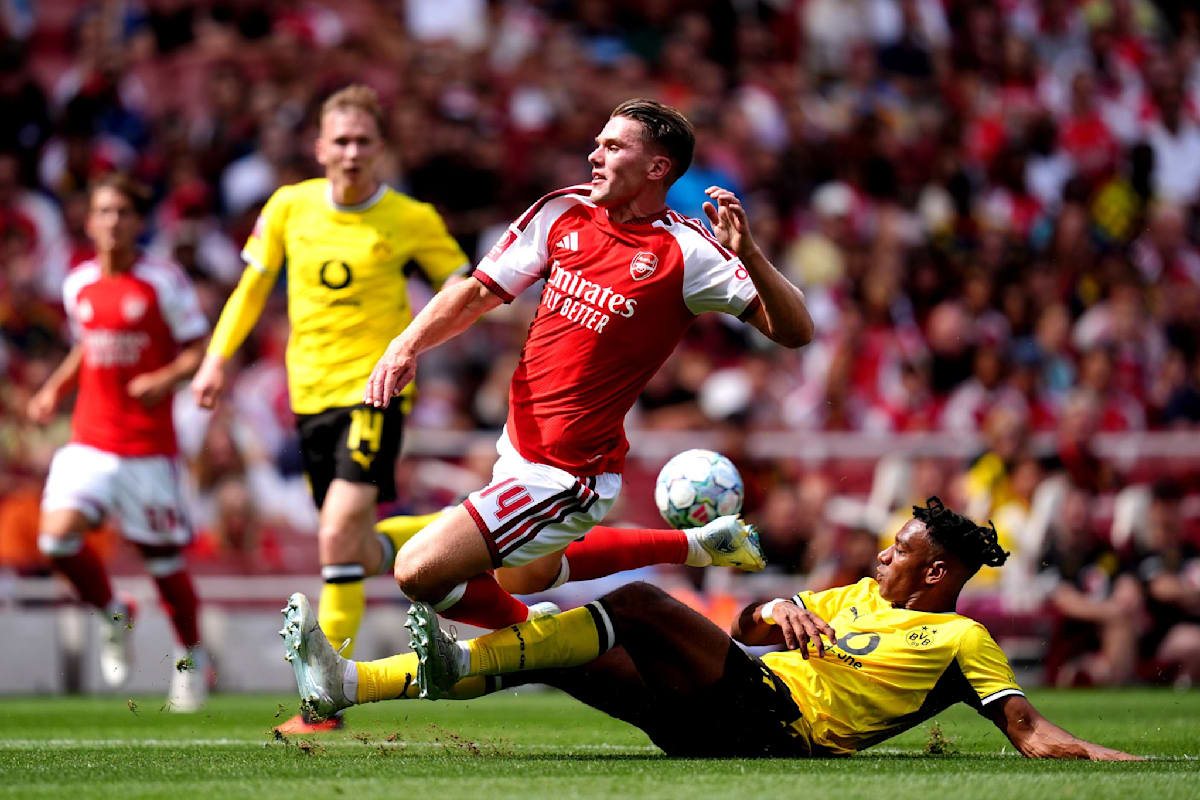
Borussia Dortmund left north London with a 3-2 win over Arsenal and one of the clearest youth stories of the European preseason. All three Dortmund goals at Emirates Stadium were scored by teenagers: Samuele Inacio and Konstantinos Karetsas, both 18, and 19-year-old center back Joane Gadou. A friendly does not decide a season, but doing that against the reigning Premier League champions gives Dortmund’s coaching staff meaningful evidence about players who may be asked to contribute sooner than expected.
Arsenal started the match with more of the ball and forced an early intervention from goalkeeper Alexander Meyer, but Dortmund struck first. In the seventh minute, Fabio Silva and Felix Nmecha moved the ball forward quickly and released Inacio, who finished into the far corner with one touch. The goal set the pattern for a first half in which the hosts had pressure but Dortmund were more ruthless whenever space opened in transition.
The second goal arrived in the 29th minute. Karetsas was given room near the edge of the penalty area and curled a left-footed shot into the corner. It was a remarkable introduction because this was his first appearance for Borussia Dortmund after only a few days of training with the club. Dortmund officials later highlighted how composed he looked despite the short adjustment period, while also stressing that younger players benefit from the structure created by experienced teammates.
Arsenal found a response after halftime. Ethan Nwaneri made it 2-1 in the 54th minute, giving the home crowd reason to believe a comeback was underway. Dortmund answered four minutes later. After a corner and a flick-on, Gadou met the ball in the air and restored the two-goal margin. The French defender later described it as his first goal for BVB. The timing mattered as much as the finish: Dortmund stopped Arsenal from turning one goal into sustained momentum.
Viktor Gyökeres converted a penalty in the 69th minute to bring Arsenal back within one. The Premier League champions pressed for an equalizer, but Dortmund held on. The teams also staged a separate penalty shootout after the final whistle at Mikel Arteta’s request. Arsenal won that exercise, but it did not change the official 3-2 match result. It was an additional piece of preseason work rather than an extension of the cup contest.
The result carries useful context for both teams. Dortmund traveled without a number of players. Emre Can, Nico Schlotterbeck and Mussa Kaba were in rehabilitation, while Gregor Kobel and Julian Ryerson had only recently returned from their break and did not travel. That gave younger players a larger role against an opponent that won the 2025-26 Premier League and reached the 2026 Champions League final. The teenagers were not simply late substitutes in a settled game; they were responsible for the decisive moments.
Dortmund coach Niko Kovač resisted treating the score as the main point of preseason. His postgame emphasis was on progress and on whether the team could reproduce the patterns it had been working on. He specifically praised the construction of the first two goals and acknowledged that Karetsas still needs time even after an eye-catching debut. That is an important distinction: a strong August performance can expand opportunity without becoming proof that a young player is ready for every situation.
For Arsenal, the calendar makes the defensive warning harder to dismiss. On August 16, the Gunners face FA Cup winners Manchester City in the Community Shield at Principality Stadium in Cardiff. That is an official trophy match, and the one-week turnaround leaves limited time to correct the transition and set-piece problems Dortmund exploited. Arsenal’s two goals show the attack could respond; the more worrying detail was conceding again only four minutes after Nwaneri had restored the home side’s momentum.
Dortmund also moves quickly toward competitive football. AS Roma visits Signal Iduna Park on August 15 for the final major preseason test, followed by Bayern Munich in the Franz Beckenbauer Supercup on August 22. A friendly result does not predict what will happen against Bayern, but it gives Kovač more evidence that he can trust players beyond the established core. It also raises the standard those teenagers will now be expected to meet in training.
The fixture revived a familiar European pairing. Arsenal and Dortmund had not met since 2014, after six Champions League group-stage meetings between 2011 and 2014. Twelve years later, the names that defined their return were not veterans from that era but teenagers at the beginning of their careers. For Dortmund, that may be the most valuable part of the win. For Arsenal, the value lies in having a demanding warning before the matches begin to count.

72