
Putin’s War Is Sending Ukrainian Children Underground to Learn
Ukraine’s first day of school revealed two childhoods in one country: ordinary classrooms in the west and shelters, underground schools and laptop-only lessons closer to Russia’s war.
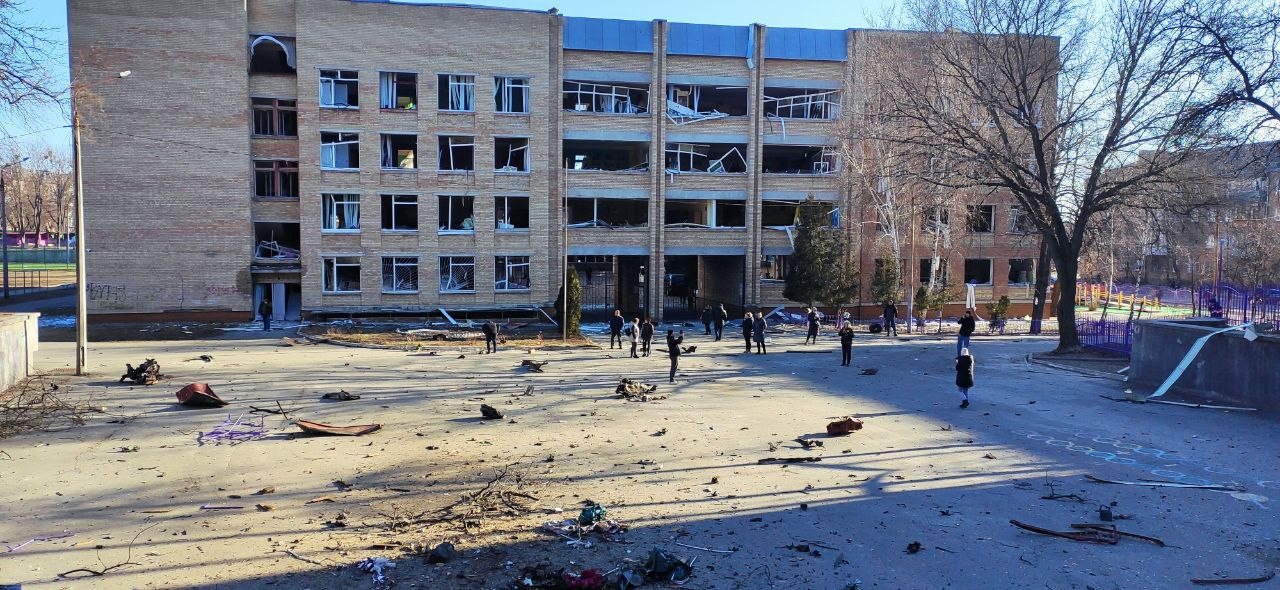
For millions of children, the first day of school is supposed to begin with a classroom, a teacher and the nervous excitement of seeing friends again. In Ukraine on September 1, that simple ritual depended increasingly on geography — and on how exposed a child’s city was to Russia’s war.
In Uzhhorod, near Ukraine’s western border, more than 17,000 children began the school year, including 1,326 first-graders. In Ivano-Frankivsk, nearly 35,000 pupils were expected back, with ceremonial gatherings largely reserved for first-graders and graduating students.
Hundreds of miles east, the same school day looked radically different.
Kharkiv opened its tenth purpose-built underground school. Sumy School No. 17 held its first-bell ceremony inside a shelter for first-graders while older pupils started remotely. Schools serving communities around Svatove in the occupied and war-scarred Luhansk region began the year online. Kherson regional authorities say most schools there have been damaged or destroyed by Russian shelling, while some remain inaccessible under occupation.
The Ukrainian publication Arhiv documented that contrast across the country, showing how the distance from the front is now changing the physical meaning of the word “school.”
This is not a metaphor. The classroom is literally moving underground.
Ukraine’s Education Ministry says more than 3.5 million pupils began the 2026/27 academic year across 11,940 schools, including 243,398 first-graders. More than 8,000 schools are teaching in person, 2,211 are using a hybrid format and 1,306 are remote. More than 82% of schools operating in person have access to an equipped shelter.
That national breakdown now functions almost like a second map of the war. The safer the region, the more likely children are to experience something recognizable as a conventional school day. The closer communities are to sustained Russian attack, the more education depends on reinforced concrete, subterranean rooms, split schedules and screens.
In Kharkiv, a school basement became an institution
Kharkiv has endured repeated Russian missile, drone and glide-bomb attacks since the full-scale invasion began. On September 1, the city opened a tenth underground school, this one in the Nemyshlianskyi district and designed for roughly 2,700 pupils.
Underground schools now operate in every district of the city. Kharkiv has 24 protected educational spaces in total, including those ten underground schools, allowing more than half of the city’s pupils to study in a hybrid format.
The interiors can look cheerful and modern, with interactive equipment, themed classrooms and places to rest. But the architectural premise is grim: children are being taught below ground because the surface cannot reliably be treated as safe.
The war is also reshaping the size of the school population. Kharkiv has about 4,600 fewer pupils than it did in 2025, including roughly 600 fewer first-graders. Families have moved, children remain abroad and parents continue to weigh education against physical risk.
Sumy’s first bell rang in a shelter
At School No. 17 in Sumy, close to Ukraine’s northeastern border, administrators invited only first-graders to an in-person first-bell event — and held it in a shelter. Other students began the year remotely.
Over the summer, families withdrew the records of 120 pupils, the school’s largest such departure during the full-scale war. Some moved deeper into central or western Ukraine. Others left the country.
That kind of movement breaks apart more than enrollment lists. It scatters childhood friendships, separates teachers from pupils and forces schools to become digital anchors for communities whose members may now live hundreds of miles apart.
Zaporizhzhia builds downward to bring children back together
Nearly 90,000 pupils began the school year in Zaporizhzhia region, including around 4,500 first-graders. On September 1, pupils from four institutions entered newly built underground schools.
For children who spent long periods learning online, the underground classroom can actually represent a return to normal social life. They can sit beside classmates, see teachers in person and continue a lesson during an air-raid alert without immediately dispersing.
Yet the price of that normality is extraordinary. Money that could otherwise go only toward teachers, laboratories, books or technology must also pay for reinforced walls, ventilation, protected exits and blast-resistant educational spaces.
Even Kyiv’s ordinary school day can end in a shelter
Ukraine’s capital has far greater capacity for in-person education. Kyiv opened 412 schools, with 401 operating in person or in a combined format. Nearly 94% of the city’s first-graders showed up on September 1.
But the war still reached into the morning. An air alert interrupted the opening day after overnight Russian strikes, and Reuters photographed first-graders sheltering during a Russian drone attack.
The distinction matters: “in-person school” in wartime Ukraine does not necessarily mean a child spends the day in a normal classroom. Shelters have become core educational infrastructure alongside cafeterias, libraries and gyms.
Putin’s war made this school map possible
Russia’s full-scale invasion began after President Vladimir Putin announced a military operation against Ukraine on February 24, 2022. The UN General Assembly condemned the Russian Federation’s aggression and demanded the withdrawal of Russian forces.
That history is directly relevant to what Ukrainian children experienced on September 1. The underground schools in Kharkiv were not built because educators discovered a new pedagogical preference. The shelter ceremony in Sumy was not a quirky local tradition. Remote schooling in occupied and frontline communities is not simply a post-pandemic choice. These are adaptations to a war launched by the Russian state under Putin.
The human cost remains current. The UN Human Rights Monitoring Mission in Ukraine reported that 17 children were killed and 166 injured in July 2026, the highest monthly number of child casualties since April 2022. Long-range missiles and drones were the leading cause of civilian casualties, demonstrating why distance from the formal front line does not eliminate danger.
Putin is also subject to an International Criminal Court arrest warrant issued in 2023 over alleged war crimes involving the unlawful deportation and transfer of Ukrainian children. The warrant is an accusation rather than a criminal conviction, but it underscores how children have become central to the international legal record of the war.
On September 1, Ukrainian pupils did what children everywhere do. They carried flowers, met teachers, searched for their desks, posed for pictures and tried to work out who would sit beside whom.
The difference is that for a growing number of them, the route to that desk now goes down a reinforced staircase. For others, school exists only through a laptop far from home.
Ukraine has kept its education system functioning through invasion, occupation and repeated strikes. But the defining question for the school year is not only whether teachers can deliver the curriculum. It is whether children can spend an ordinary day learning without having to hide from the war above them.
92