AOC says healthcare anxiety behind MAHA advocates' fight is not partisan
Rep. Alexandria Ocasio-Cortez says MAHA activists' concerns about healthcare cost, corporate influence and institutional distrust cross party lines.
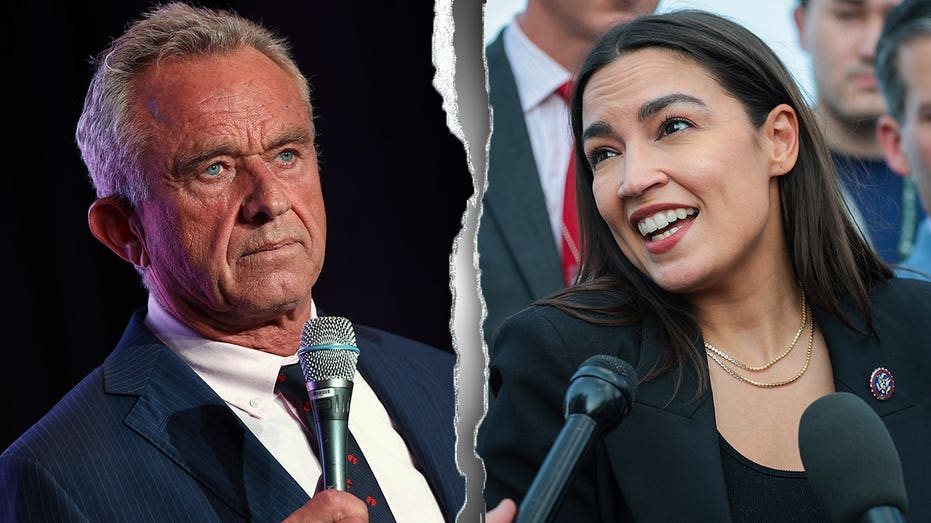
Rep. Alexandria Ocasio-Cortez, D-N.Y., says the anxiety driving the Make America Healthy Again movement is not simply a partisan battle, blaming a healthcare system that leaves many Americans unable to afford care and unsure whom to trust.
Appearing on the podcast «The Majority Report with Sam Seder», Ocasio-Cortez said she meets and works with MAHA activists because their concerns cut across political lines.
«I actually meet with MAHA activists. I work with MAHA advocates, because a lot of them really don't believe that their fight is partisan — and it's not in many ways,» she said.
The movement, whose name was championed by Health and Human Services Secretary Robert F. Kennedy Jr., has grown out of public discontent with U.S. healthcare policies. Ocasio-Cortez echoed that discontent during the interview, criticizing what she called corruption in agriculture and large corporate systems.
«We do have extraordinary corruption in our agricultural system, in our big corporate system as well,» she said. «This is an area where both parties — and our entire political system — has been compromised.»
The New York Democrat recalled joining congressional investigations into PFAS contamination after arriving in the House. PFAS, often called «forever chemicals», have been linked to a wide range of health problems. She said companies have for decades dumped hazardous byproducts into communities and then used political influence to escape accountability.
«They just pay off our political class to ignore it and to let it continue to happen, or to shield them legally, like with glyphosate, from everyday people trying to get that back,» she said.
A 2025 study by Sweden's Uppsala University, published in the journal Environment International, found that two common environmental contaminants, PFAS and PCBs, may increase the risk of multiple sclerosis.
Ocasio-Cortez also pointed to the rising cost of healthcare and the fear that follows a diagnosis. She described a common dilemma: people who get sick want to reduce exposure to toxic products, but when they cannot afford medicine or a doctor, they look for holistic and low-cost alternatives.
«It's because there's a ton of anxiety around our healthcare system,» she said. She added that her own family background helped her understand those feelings, noting that she was raised in a religious household shaped by both Catholic and evangelical traditions. Issues that are often presented as right-wing concerns, she said, are frequently working people's anxieties about being unable to afford healthcare.
Ocasio-Cortez singled out racial disparities and historical mistreatment as another source of distrust. She noted that she is Puerto Rican and that the United States sterilized Puerto Rican women for decades. She also cited COVID and vaccine skepticism in Black communities, describing a «perfect storm» of valid and understandable mistrust in institutions.
«If you add the racial component too — I'm Puerto Rican, the United States sterilized women for decades,» she said. «And so you have COVID, you have vaccines and obviously in the Black community, same thing. That is a perfect storm of a lack of trust in institutions that is oftentimes very valid and very legitimate.»
She warned that condescending responses to public fears would only deepen the problem, and that the healthcare system itself must be fixed.
Public relations executive Jason Mudd, chief executive of Axia Public Relations, said Ocasio-Cortez was attempting to build a bridge rather than convert MAHA supporters to her politics. The shared grievance, he said, is that Americans do not trust the system meant to protect them and cannot afford to get sick. «That's not a left issue or a right issue. That's every American's issue.»