Taiwan plans 16% defense spending increase for 2027
The proposed NATO-style total would exceed NT$1.1 trillion for the first time, extending a multi-year buildup focused on deterrence, resilience and asymmetric capabilities.
Taiwan is preparing another major increase in defense-related spending as its government tries to turn military modernization into a sustained national policy rather than a sequence of emergency packages. Reuters reported on Aug. 9 that the Cabinet plans to propose an increase of about 16% for 2027, taking the broad NATO-style total above NT$1.1 trillion for the first time. The detailed proposal is expected to be unveiled on Aug. 20.
The headline number needs some explanation. Taiwan’s NATO-standard calculation is broader than the Ministry of National Defense’s own budget. It includes Coast Guard spending, veterans’ retirement payments and special defense programs. For 2026, the government puts that aggregate at NT$949.5 billion, equal to 3.32% of gross domestic product. The MND itself accounts for NT$806 billion of that amount.
That distinction matters because it shows the increase is not simply a 16% rise in weapons procurement. Some of the money supports personnel-related obligations and maritime security institutions outside the military’s core budget. Still, the direction is unmistakable. Taiwan’s MND says it intends to keep defense spending at no less than 3% of GDP and to sustain growth as it expands readiness, stockpiles, command resilience and military investment.
The policy is driven by Taipei’s assessment of pressure from the People’s Republic of China. Taiwan’s defense ministry says increasingly varied Chinese military activity has compressed warning times and created a need for forces that can remain operational under sustained pressure. Beijing’s position is fundamentally different: Chinese authorities say Taiwan is part of China and reject moves they characterize as separatist. The competing political positions sit behind every major defense decision on the island.
For the United States, the budget also intersects with a long-standing arms relationship. Taiwan’s legislature in May approved a special framework capped at NT$780 billion for packages of U.S. military equipment. The figure was narrower than the government’s earlier concept for a broader defense-resilience program, and Taiwan’s MND argued that some direct commercial and domestically commissioned projects were left outside the legislation. The episode showed that support for stronger defenses does not eliminate domestic disagreement over how the money should be spent.
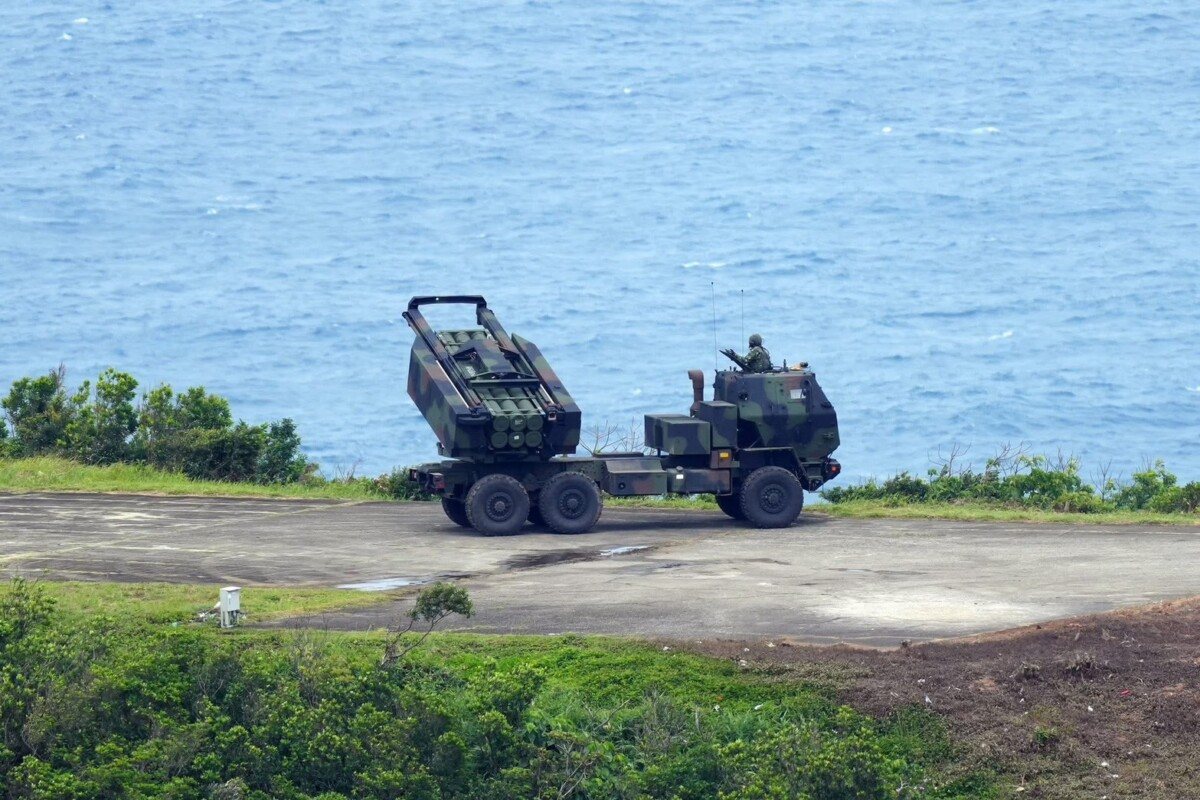
The modernization strategy increasingly emphasizes systems designed to complicate an attempted attack rather than simply mirror the larger force across the Strait. An MND special-budget proposal for 2026 through 2033 listed precision artillery, long-range precision missiles, air defense, missile defense and anti-armor weapons, unmanned systems and counter-drone capabilities. It also included sustainment equipment, AI-assisted command systems and C5ISR — the networks that connect command, control, communications, computers, intelligence, surveillance and reconnaissance.
Taiwan is also investing in capabilities that require years of domestic industrial development. Its indigenous submarine program is the clearest example. Official budget documents call for seven follow-on boats after the Hai Kun prototype, with a total program budget of NT$284.0808 billion running through 2038. The project is intended to add an undersea deterrent while building local shipbuilding and systems-integration expertise that cannot be acquired overnight.
The 2027 proposal therefore represents more than a record in nominal spending. It is an effort to create predictable funding for a defense model based on dispersion, redundancy and endurance. Missiles and drones attract the most attention, but the strategy also depends on maintenance, ammunition reserves, communications backup, hardened infrastructure and the ability to replace losses. Those less visible expenses can determine whether sophisticated platforms remain useful during a prolonged crisis.
The Aug. 20 release should clarify how much of the increase will go to the core military budget and how much will be allocated to the Coast Guard, veterans and special projects. It will also show whether investment spending grows faster than personnel and operating costs. After that, lawmakers will still have a role in shaping the final package, as they did with the special U.S.-arms framework earlier this year.
For Washington and other partners, Taiwan’s spending trajectory will be read as one measure of its willingness to carry a larger share of the burden of its own defense. For Taipei, however, the more immediate test is practical: whether larger appropriations translate into trained units, distributed weapons, resilient networks and enough stocks to deny an adversary the expectation of a quick victory. The size of the budget is a signal. Its execution will determine whether the signal becomes credible deterrence.
A second test will be absorption capacity. Major procurement programs can fail to create timely capability if delivery schedules, training pipelines and infrastructure do not keep pace with appropriations. Taiwan will therefore need to demonstrate that the additional money is matched by enough personnel to operate new systems, maintenance capacity to keep them available and command networks able to integrate them. In defense policy, the gap between a funded item and a fielded capability can be measured in years.
That is why oversight will matter as much as ambition. A larger budget gives Taipei more options, but it also creates more opportunities for delays and inefficient sequencing. The most convincing evidence of progress will not be another record headline in 2028; it will be shorter delivery timelines, deeper stocks, better distributed units and reliable systems that remain connected under stress. If those indicators improve, the 16% increase will have strategic substance beyond its political symbolism.
69