Masterson and Holscher win Kansas gubernatorial primaries
Kansas Republicans selected Senate President Ty Masterson as their nominee for governor, setting up a November matchup with Democratic state Sen. Cindy Holscher to succeed term-limited Gov. Laura Kelly. The primary also featured a ballot measure that would change how the state selects Supreme Court justices.
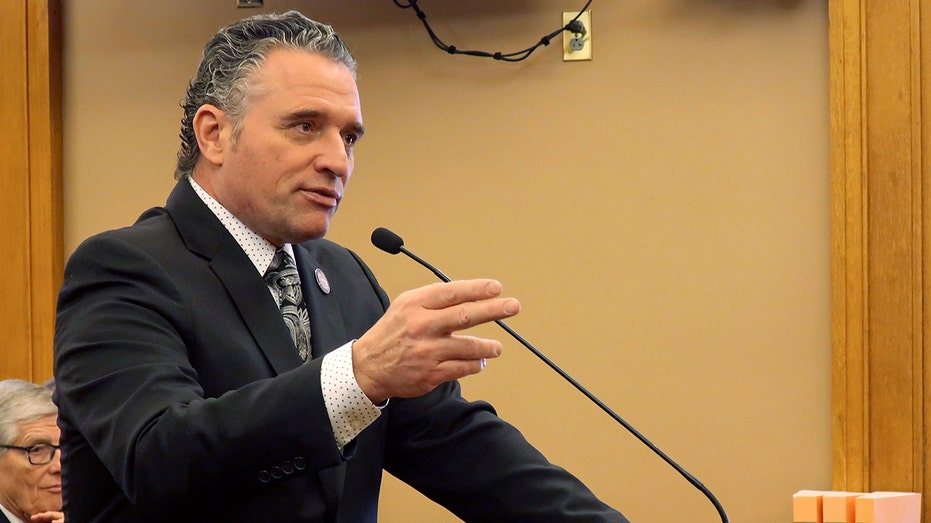
Kansas Republicans have chosen state Senate President Ty Masterson as their nominee for governor, setting up a Nov. 3 general election against Democratic state Sen. Cindy Holscher to succeed term-limited Gov. Laura Kelly. Kelly, a Democrat, has led Kansas for two terms, and the open-seat race is viewed by Republicans as a prime opportunity to reclaim the governor's mansion in the 2026 midterm cycle. Democrats, in turn, are hoping to keep the office in a state that has voted overwhelmingly Republican in recent presidential elections.
Masterson, who leads the Kansas Senate, finished ahead of a crowded Republican field that included Secretary of State Scott Schwab, Insurance Commissioner Vicki Schmidt, former Johnson County Commissioner Charlotte O'Hara, businessmen Nick Reinecker and Philip Sarnecki, and former Johnson County Sheriff Stacy Rogers. Schwab and Schmidt are current statewide officeholders, while O'Hara, Reinecker, Sarnecki and Rogers came from local government, law enforcement and private-sector backgrounds. The campaign centered on familiar conservative priorities, including tax relief, education, immigration, public safety and cultural issues, as the candidates sought to stand out through their leadership records and competing visions for the state's future.
Holscher, a state senator, won the Democratic nomination over fellow state Sen. Ethan Corson and Overland Park Mayor Curt Skoog. Her nomination gives Democrats a candidate to defend the governorship after Kelly's tenure ends. The party has said it hopes to extend its hold despite Kansas' strong Republican lean. In 2024, Trump carried the state with 57 percent of the vote, underscoring the challenge Democrats face in statewide elections. Still, the governorship has frequently shifted between parties in recent years, with voters alternating between Democratic and Republican leadership despite the state's red tendencies.
The general election will decide who succeeds Kelly when she leaves office in January. Because she is term-limited, neither party had an incumbent to defend, and both primaries drew significant interest. Taxes, education, immigration, public safety and the direction of state government are expected to dominate the fall campaign. Masterson enters the general election as the Republican nominee in a strongly Republican state, while Holscher will try to put together the coalition that kept the governorship in Democratic hands for the past two terms.
Tuesday's primary coincided with a closely watched constitutional amendment that would change the way Kansas picks its Supreme Court justices. The proposal, backed by Republican lawmakers, would replace the state's current appointment method with direct elections. It comes after years of conservative criticism of the Kansas Supreme Court, particularly over decisions involving abortion, school funding and election law. If approved, the amendment would modify the Kansas Constitution to require justices to be elected by voters rather than chosen through the state's nominating commission system.
With the primaries now decided, the race becomes one of the most closely watched governor's contests of the 2026 cycle. Republicans view the open seat as a chance to flip the governor's mansion after two terms of Democratic control, while Democrats see it as a test of whether they can hold ground in a red state. Both parties are expected to focus heavily on the campaign between now and November, making Kansas a key battleground in the broader midterm elections.