Cameroon’s 93-year-old president has stayed abroad for more than two months
Paul Biya left Yaounde on June 7 for what his office called a brief private stay in Europe. Officials say he is working from Geneva, while the prolonged absence has sharpened a succession debate.
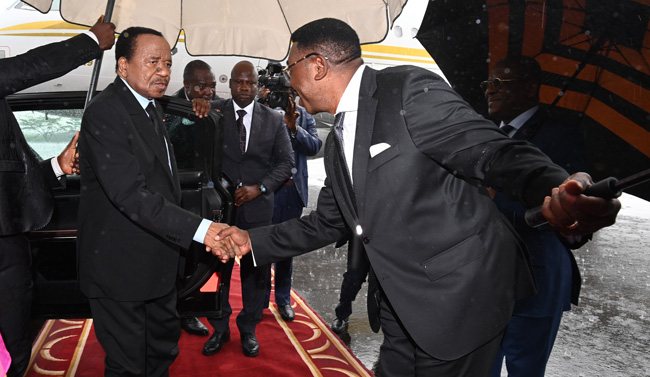
Cameroon’s President Paul Biya has spent more than two months outside the country after leaving on a trip his office initially described as brief. The presidency announced on June 7 that the 93-year-old leader had departed Yaounde with his wife, Chantal Biya, for a “brief private stay in Europe.” The government later confirmed that he was in Geneva, Switzerland. No public timetable for his return has been announced.
That makes the story less a mystery about where Biya is than a question about how long a president can remain abroad without creating a political vacuum. There has been no independently confirmed public appearance by Biya since his departure. Government officials, however, insist that he remains active. Communications Minister Rene Emmanuel Sadi has said the president is in good health and working from Geneva, while other officials say state files continue to reach him.
Health speculation has complicated the picture. Some news reports, citing unnamed sources, have alleged that Biya was hospitalized or underwent medical treatment in Switzerland. Cameroon’s government issued a formal denial of the hospitalization claims. Samuel Mvondo Ayolo, the director of the president’s civil cabinet, also told Le Monde that Biya had not been hospitalized or operated on and was working from his hotel. Those medical allegations remain unverified and should not be treated as established fact.
The political stakes are unusually high because Biya is the world’s oldest sitting president and one of its longest-serving national leaders. He took power in 1982 and began an eighth term late last year after an election whose outcome was widely disputed by opposition groups. A 2008 constitutional amendment eliminated presidential term limits, allowing him to continue seeking reelection. If he serves the full current term, he would be close to 100 years old when it ends.
The latest absence has highlighted a gap in Cameroon’s succession structure. Constitutional changes in April restored the office of vice president, a position that could play a decisive role if a president became unable to serve. Biya has not filled the post. At the same time, Cameroon’s constitution does not set a specific maximum number of days a president may spend outside the country. The result is a system with no clear travel limit and, for now, no sitting vice president.
Opposition leaders have seized on that ambiguity. Some have described the government as being on “autopilot” or said Cameroon is being run by “remote control.” Those are political characterizations, not legal findings that Biya is incapacitated or that the presidency is vacant. The government’s response is that the president is still exercising his authority and that the machinery of state continues to operate.
There is evidence of ongoing presidential action. In early August, Biya reshuffled Cameroon’s senior military leadership, replacing commanders in four of the country’s five joint military regions and promoting several senior officers. The changes were significant in a country that faces security pressure from Boko Haram in the north and a long-running separatist conflict in the English-speaking west. No official reason for the broader reshuffle was announced.
Biya’s age also stands in striking contrast to Cameroon’s demographics. More than 70% of the country’s nearly 30 million people are under 35, according to reporting by The Associated Press. Many Cameroonians have known no other president. That generational divide has become politically important as younger citizens confront stagnant economic conditions, unemployment and inadequate infrastructure while watching the same leader remain in office for more than four decades.
For an American audience, the central issue is institutional rather than personal. Presidents and prime ministers regularly travel and can continue working from abroad. What distinguishes the Cameroon case is the duration of the trip, the extreme longevity of Biya’s rule and the uncertainty surrounding who is next in line if he cannot serve. A government can remain legally functional while still facing questions about transparency, accountability and succession.
The most defensible description, therefore, is not that Biya has “disappeared.” His government says he is in Geneva. The verified story is that a 93-year-old president who has ruled since 1982 left on June 7 for a stay described as brief, remained abroad for more than two months without a declared return date, and continued to exercise formal powers while opposition parties challenged the legitimacy of that arrangement. Until he reappears publicly or the presidency announces a return, those institutional questions will remain at the center of Cameroon’s politics.
64