Sacha Baron Cohen Defends Satire as a Tool Against Injustice
In a new essay, Sacha Baron Cohen argues that satire, from Aristophanes to Borat, has always been a weapon of the powerless against entrenched power, even when it offends.
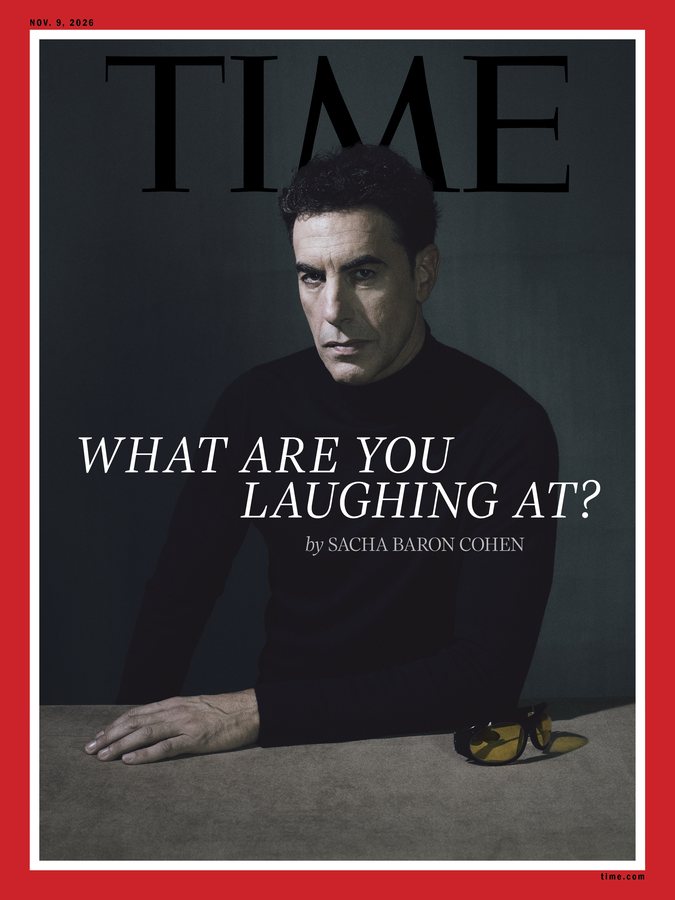
Sacha Baron Cohen is pushing back against critics who see his comedy as cruelty rather than critique. In a new essay, the actor and satirist argues that satire has always been a weapon of the dispossessed, a tradition he traces from medieval France through ancient Greece to his own characters like Borat and Ali G.
Cohen describes his first encounter with satire at age 8, when his older brothers smuggled him into a London cinema to see Monty Python’s Life of Brian. He recalls the feeling of being surrounded by 300 people screaming with laughter, even if his young brain could not fully grasp the film’s critique of religion or leftist infighting. That experience led him to comedy greats like Peter Sellers and Peter Cook, and eventually to a six-month study with the late French clown teacher Philippe Gaulier, who introduced him to the bouffon.
In Gaulier’s telling, the bouffon tradition dated back to 11th century France, when societal outcasts — gay people, heretics, those with deformities — were let back into their villages once a year to put on shows viciously mocking the ruling class. It was, Cohen writes, the humor of the dispossessed. Whereas clowns were naive idiots, bouffons savagely undermined the people in power, using biting and at times cruel humor to challenge systemic injustice.
That tradition, Cohen argues, runs through history. The Greek playwright Aristophanes lampooned the militarism and demagoguery of his day, yet critics like Plutarch sneered at his coarseness. The Roman satirist Juvenal was barely acknowledged by his contemporaries. Nearly two millennia later, Lenny Bruce’s four-letter comedy was branded «sick» in the pages of this magazine in 1959. Cohen’s message to those critics is blunt: they missed the point.
Cohen acknowledges that satire can offend people other than its intended targets, and that his own work has done so. But he insists that he has opposed bigotry and injustice throughout his life and partnered with civil rights groups, and that he does not recognize himself in the warped portrayals of him that sometimes circulate on social media, lumped in with the bigots he lampoons. His characters, he says, are designed to expose prejudice, bias, and stupidity.
He offers Ali G as an example: a white imbecile and delusional cultural appropriator who steals the fashion and lyrics of his favorite gangsta rap and dancehall idols. The joke, Cohen writes, is on him and on the predominantly white male establishment who take him seriously enough to believe HBO would hire the stupidest man in the world as an interview host. Like a good bouffon, Ali G undermines that establishment, not the culture he borrows from.
Cohen admits that most of his humor is juvenile, but argues that satire works best not when it preaches but when it lives among the laughter. Once the audience leaves the theater or switches off the TV, it makes them think. He recalls attending a fox-hunting rally while creating Borat, asking the English toffs whether they thought criminals should be hunted in his country. Shockingly, even though on camera, they said yes. A light bulb exploded in his 25-year-old brain: real people believed this ridiculous character and would speak to him more freely than in any documentary.
Each of his characters, he explains, has a specific mechanism to encourage people to drop their guards. Borat, an antisemitic journalist, exposes Jew hatred, xenophobia, sexism, and casual racism. Erran Morad, a stereotype of a tough-guy Israeli commando, exposes Islamophobia and the ludicrous things people will do when gripped by irrational fear of «the other.» Ali G, who is not extreme but extremely dumb, leads powerful people to underestimate him and answer in earnest, revealing their own biases.
Other characters highlight societal problems without engaging real people at all. The Dictator’s Admiral General Aladeen, a cartoonish ruler of a fictional Horn of Africa nation and a mash-up of personality-cult authoritarians, warned in 2012 how easily democracies could fall into autocracies. Regardless of the madness, Cohen writes, the method is the same: make the audience laugh as hard as possible while holding up a mirror to reflect things that are not always comfortable to see.
He points to Charlie Chaplin’s The Great Dictator as proof that brutally honest satire can be cuttingly effective. At a time when Hollywood largely avoided anti-Nazi content, Chaplin, then one of the most famous movie stars in the world, used the film to point to the destruction wrought by authoritarianism. For Cohen, that is the enduring power of satire: it speaks through laughter to truths that power would rather keep quiet.
8