Why AI Makes Information Cheap but Leaves Decisions Hard and Human
A new analysis argues that generative AI floods offices with easy information while human accountability for decisions remains essential, citing workplace productivity losses, rising error rates and EU rules requiring human oversight.
Generative AI has made information cheap, but the hard part of work has not gotten any easier. Decisions still have to be made by people who can be held to account for them, and a growing body of evidence suggests that companies are struggling to keep those two things distinct.
A 2025 survey by BetterUp Labs and Stanford found that 40 percent of US desk workers had received « workslop » in the previous month, a term for AI-generated output that looks finished but adds little to the task at hand. According to the figures cited in the analysis, each incident costs the recipient about two hours. Extrapolated to a ten-person team, the author estimates a loss of roughly 20 hours a month, time spent sorting, checking and correcting material that should have helped rather than hindered.
The author places this problem within a longer arc of technological change. Agriculture took around 10,000 years to give way to industrialisation, while the digital shift has unfolded in a fraction of that time. The Advanced Research Projects Agency Network, the forerunner of the internet, first connected computers in 1969. Open web projects such as Project Gutenberg and Wikipedia, which gathered vast amounts of human-written text, are now seen as groundwork for the training of large language models. The speed of change, the analysis argues, leaves organisations little time to adjust their habits of judgement.
Much of the argument rests on a familiar model of knowledge. The DIKW pyramid, popularised by Russell Ackoff in the late 1980s, moves from data to information, then to knowledge and finally to wisdom. In 1987, Milan Zeleny recast those levels as know-nothing, know-what, know-how and know-why. In that framing, AI performs strongly when turning data into know-how, the ability to carry out a process. It is far weaker at the know-why layer, where priorities, interests and context determine what should be done at all.
Reliability is a concern at the level of the tools themselves. The Vectara hallucination leaderboard recorded rates for summarisation in 2026 ranging from 1.8 percent to 24.2 percent, depending on the model. The author contends that these errors are only part of the problem. A deeper risk is that human intentionality, the awareness, context, prioritisation and distillation that people bring to their work, is being eroded when machine output becomes the default starting point.
The analysis also returns to an old question of responsibility. A slide widely attributed to IBM in 1979 stated that a computer cannot be held accountable, and therefore should not make management decisions. The author notes that the original slide has not been located, so its provenance remains disputed, but the principle has endured. The European Union's AI Act gives it legal form. Article 26(2) requires that high-risk systems be overseen by competent and authorised people. Decisions with serious consequences, including insurance, loans, schooling and benefits, need named humans who can answer for the outcome.
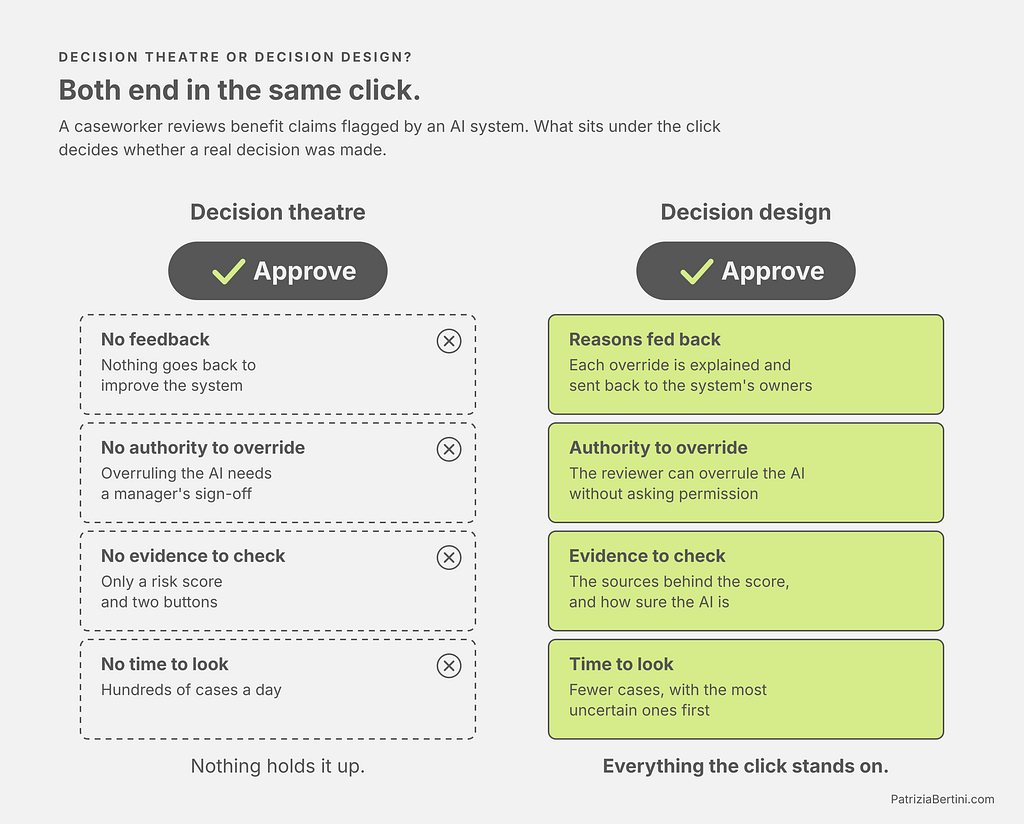
That requirement, the analysis warns, can be met in name only. The author describes « decision theatre », a setup in which a person formally approves a machine recommendation without any real capacity to decide otherwise. An illustrative caseworker reviewing an automated benefits recommendation might click approval within seconds, with no time, information or authority to question it. The author contrasts this with « decision design », in which people are given the skills, the authority and a supportive process to exercise genuine judgement.
Frontline staff matter in this model. Tacit knowledge, the experience and discretion of workers who understand how a process actually operates, still matters in digitalised work, and the analysis argues that organisations which strip it out in the name of efficiency will find their decisions less sound. The choice, in the author's account, is not between people and machines but between oversight that is real and oversight that is performed.
Source: uxdesign.cc
24