Ferrari F1 Concept by Luca Serafini Reimagines Open-Wheel Racing as Sculpture
Italian designer Luca Serafini unveils a Ferrari F1 concept that strips away modern aerodynamic clutter and the halo, offering a sleek, sculptural take on open-wheel racing while acknowledging the 2026 regulations that would make such a design unviable on the track.
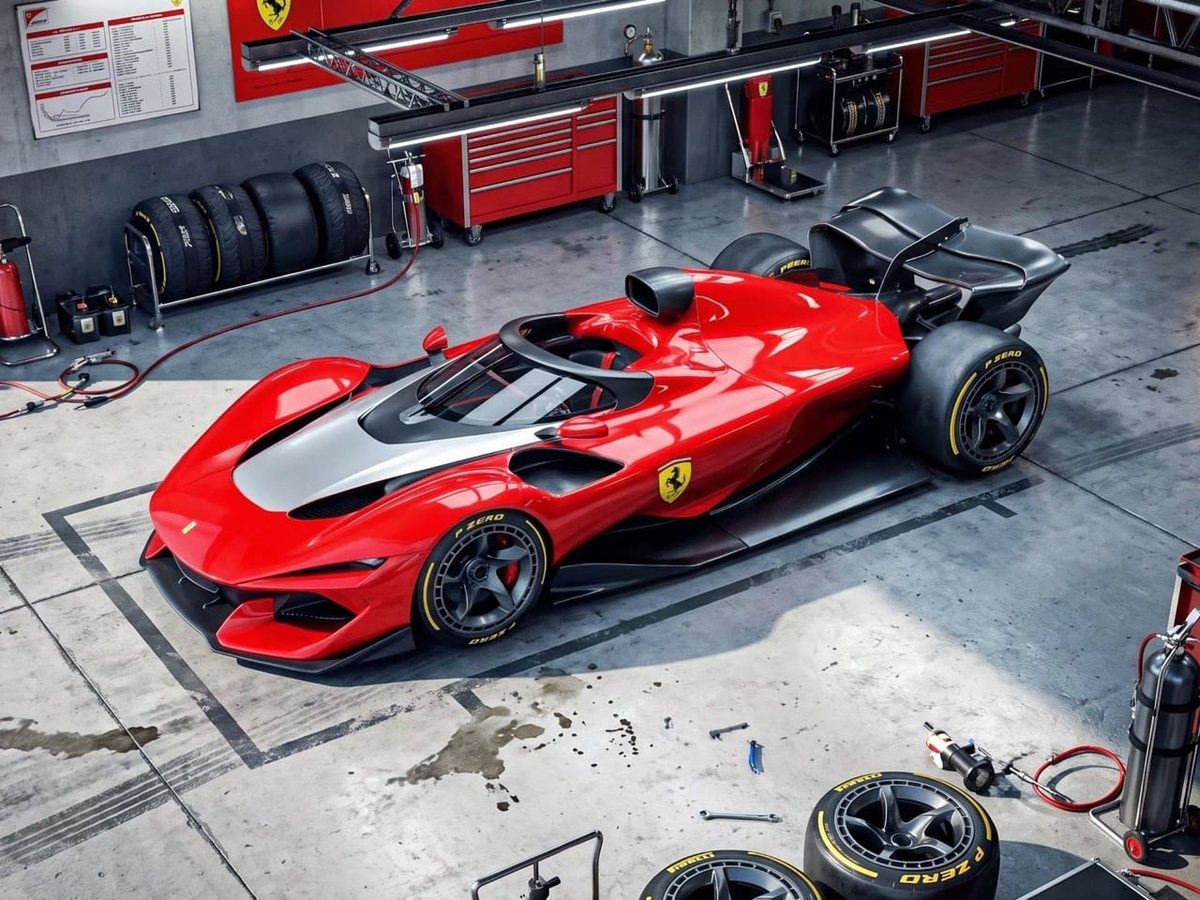
Italian designer Luca Serafini has unveiled a Ferrari Formula 1 concept that trades the angular, sponsor-laden look of modern race cars for a smooth, sculptural silhouette, reviving a decade-old idea from Ferrari’s own design studio. The single-seater, developed under his LS Design banner, reimagines the open-wheel racer with bodywork that flows seamlessly from the front wheels into the sidepods, while the rear wheels remain exposed on yellow-banded slicks. The result is a car that looks less like a machine assembled from a parts bin and more like a single, poured volume of red paint.
The concept draws on a 2015 proposal from Ferrari’s Centro Stile, which had floated a similar idea of making F1 cars visually appealing without breaking technical regulations. That earlier project, featuring a twin-deck front wing and wheel-hugging bodywork, never progressed. Serafini, who has built a portfolio of alternative Ferrari designs, including last year’s reinterpretation of the 849 Testarossa with 3D modeler Aldo Russo, picked up the argument a decade later. His approach, he has said, is to update the logic of heritage cues rather than copy their shapes, and that philosophy is evident throughout this concept.
The most striking departure from current F1 machinery is the absence of the halo, the protective device mandated since 2018. In its place, Serafini has drawn a swept structural screen bridging the cockpit opening, similar to IndyCar’s aeroscreen, with a periscope-style airbox scoop rising behind the driver’s head that evokes 1970s race cars. The design also eliminates the vanes, barge boards, and serrated flicks that dominate modern aerodynamics, leaving one unbroken red volume from nose to rear haunch, with a black splitter, floor, and rear wing sitting underneath like a visible chassis.
The renders place the car in a realistic Ferrari garage, with mechanics and Pirelli tire racks, and the Rosso Corsa paint is accented by a white central spine running from nose to airbox, a nod to 1960s prototype racers. Five-spoke centerlock wheels with blue nuts and a swan-neck rear wing complete the look. It is a vision close enough to reality that it is easy to forget the car was never built to survive contact with the actual rulebook.
That rulebook, however, has just been rewritten in ways that directly contradict this design. The 2026 F1 regulations remove the wheel arch fairings that curved over front tires on recent cars, reintroduce barge boards to manage wake, cut minimum weight by 30 kilograms, and shrink wheelbase by 200 millimeters. Every gram of Serafini’s smooth, appendage-free bodywork would cost real lap time on a real circuit. The concept is therefore a styling argument dressed up as a race car, not a practical proposal for the grid.
Serafini’s screen solution also revisits a debate explored by other designers, such as Olcay Tuncay Karabulut’s closed-canopy F1 concept, which tackled cockpit safety from the opposite direction. Serafini’s design splits the difference between a fully enclosed canopy and the open halo drivers race with today, though it does not fully solve either problem. What it does do is highlight how much personality F1 has surrendered in pursuit of regulation compliance, one flap and winglet at a time.
72