AI Use for Local Search Jumps Sixfold as Consumer Trust Lags
SOCi's 2026 Local Discovery Index finds that 52% of U.S. consumers now use AI tools to find local businesses, up from 9% a year earlier, but most verify AI answers elsewhere before making a decision.
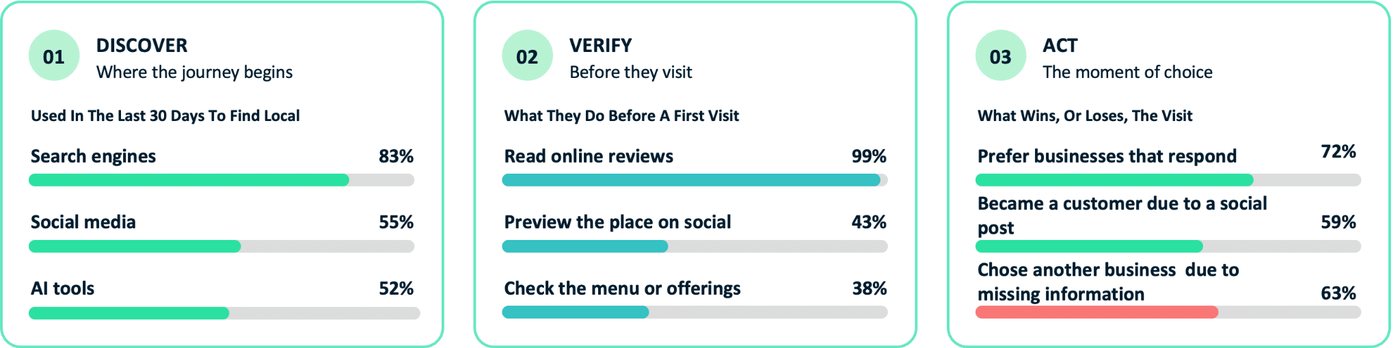
American consumers have rapidly adopted artificial intelligence tools to find local businesses, but they are not trusting what those tools tell them. According to SOCi's 2026 Local Discovery Index, an annual survey of more than 1,000 U.S. consumers now in its third year, the share of people who used an AI tool to find a local business in the prior 30 days climbed from 9% in 2025 to 52% in 2026 — close to a sixfold increase in a single year.
The surge marks a sharp break from the long-standing model in which a consumer searched on Google, evaluated results, chose a business, and converted. That linear funnel is giving way to what the study calls a verification loop: people discover a business on one channel, cross-check it on another, and make a final decision on a third, often within the same few minutes.
Search remains the most widely used discovery channel at 83%, followed by social media at 55% and AI at 52%. But no single channel is both complete and trustworthy on its own. AI is fast but sometimes wrong, reviews are credible but rarely cover everything a consumer needs, and search is comprehensive but unfiltered. Consumers compensate by triangulating among them.
The trust gap is substantial. Among AI users, 67% say they have received wrong information about a local business at least once, and 30% say that bad information caused a real inconvenience. Only 27% say their trust in AI has grown over the past year, while 23% report that their trust has declined.
That skepticism drives verification behavior. When an AI tool recommends a business, 81% of consumers take some verification step first, checking reviews (33%), the business's social media (20%), search (16%), or multiple sources (12%). Only 19% go straight from an AI recommendation to contacting the business.
Adoption is uneven across the population, a detail that matters for businesses segmenting by demographics. Regular AI use rises from 47% among consumers earning under $50,000 to 76% among those earning $100,000 or more. By generation, Millennials are the heaviest users at 63%, ahead of Gen Z at 49% and Gen X at 48%, with Baby Boomers far behind at 11%. The likeliest AI researchers, the study suggests, are Millennials with money to spend.
Consumers seek AI out directly — 57% use ChatGPT and 51% use Gemini — and also encounter it passively inside tools they already use. About 51% have seen an AI answer at the top of Google results, 35% have clicked into Google's AI Mode, and roughly a third have encountered AI content on Meta's platforms or in mapping apps.
Social platforms are increasingly functioning as search engines. Use of social media to discover local businesses rose from 17% in 2024 to 55% in 2026, and 43% use social specifically to preview what a place is like before visiting. Among social searchers, Facebook leads at 73%, followed by YouTube at 69%, Instagram at 67%, and TikTok at 50%. Notably, the leading platforms are the older, high-reach ones rather than the newest, and YouTube's second-place finish points to demand for video that shows the atmosphere of a place or lets a service provider display expertise.
Social also converts. Fifty-nine percent of consumers say a social post or video has turned them into a customer of a local business, climbing to 70% among Millennials and holding above half for Gen X at 54% and Gen Z at 52%, while dropping off among Baby Boomers at 22%.
Reviews remain the decisive filter. Ninety-nine percent of consumers read reviews before a first visit at least some of the time, and 68% do so always or most of the time. Businesses that respond to reviews are favored by 72% of consumers, and 63% have walked away from a business that could not answer a question they needed answered.
The findings carry a clear implication for local businesses and the marketers who serve them. Appearing in an AI-generated answer is necessary but not sufficient. A business that shows up in an AI response but has thin reviews or an inactive social presence risks losing the customer at the next step of the loop. AI visibility and reputation are not separate problems to manage; they are stages of the same evaluation process, and cross-channel consistency now carries higher stakes than ever.
13