AI Could Make Digital Accessibility Adaptive Instead of Static
A growing push in user-experience design asks whether artificial intelligence can transform accessibility from fixed accommodations into personalized, context-aware experiences that adjust to each user's needs in real time.
Digital accessibility has long relied on fixed standards and checklists, but a growing conversation among designers and researchers asks whether artificial intelligence could turn it into something more fluid: experiences that adapt to each person's abilities and circumstances rather than forcing users to conform to a single static design.
The question at the center of that debate is straightforward. If technology is becoming increasingly dynamic and personalized, why should accessibility remain static? The evolution of digital accessibility has produced principles, standards, and tools for identifying and removing barriers, yet the accommodations themselves have largely stayed the same. As interfaces grow more intelligent, the argument goes, inclusion should evolve alongside the people and contexts it is meant to serve.
Accessibility was never originally a digital design problem. It grew out of a broader movement recognizing that people with disabilities should participate equally in society, tied to ideas of human rights, equality, independence, and participation. For much of the 20th century, the focus was on the physical environment — buildings, transportation, public facilities, workplaces, and public services. A 1978 protest in Denver highlighted the cost and difficulty of scheduling accessible public transportation, part of a long push for equal access.
Over time, understanding of disability shifted. Researchers, advocates, designers, and policymakers increasingly recognized that the environment itself creates barriers, not just an individual's impairment or health condition. A wheelchair user is not inherently prevented from entering a building; a building without an accessible entrance creates that barrier. Similarly, a blind person is not prevented from using a computer simply because they cannot see the screen — the absence of appropriate accessibility support creates the obstacle. The World Health Organization uses such examples to show how inaccessible environments restrict participation and inclusion.
That perspective became central to digital accessibility. The web can remove many barriers of the physical world, such as distance, mobility constraints, and auditory or visual restrictions. But when websites, applications, and digital technologies are poorly designed, they create new barriers to communication, interaction, and participation.
The international standard ISO 9241, which covers human-system interaction, defines accessibility as the extent to which products, systems, services, environments, and facilities can be used by people with the widest range of user needs, characteristics, and capabilities to achieve identified goals in identified contexts of use. In simple terms, accessibility means making sure people with different abilities can access, understand, and use something to accomplish what they want to do. The definition does not apply only to people with permanent disabilities, since anyone can be temporarily disabled.
Accessibility is also about context. A person may complete an interaction easily in one situation and encounter a barrier in another. Someone who normally relies on audio may suddenly be unable to listen to sound. Someone may read comfortably in a quiet room but struggle in bright sunlight. Someone with full motor control may temporarily have only limited use of their hands. These shifting circumstances suggest that a single fixed accommodation cannot cover every user or every moment.
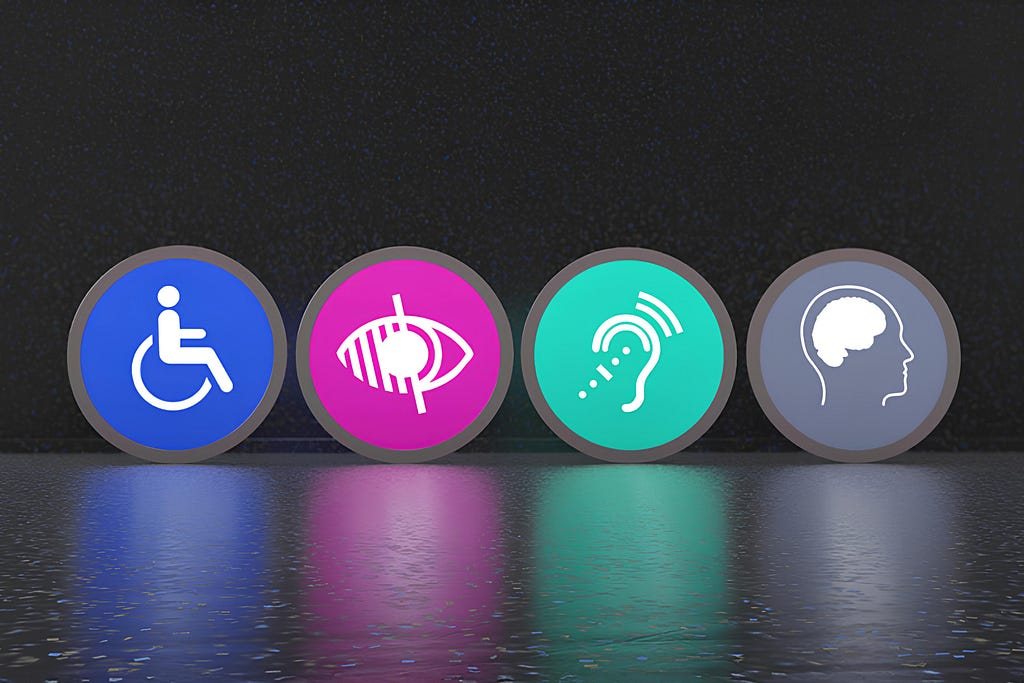
Four main functional disability categories are commonly cited — physical, vision, hearing, and cognitive — and each can vary in degree and duration. An adaptive approach would use artificial intelligence to detect or respond to those differences, adjusting layout, contrast, audio, input methods, or language complexity in real time. Instead of requiring users to find and enable settings, the system could anticipate needs based on context and past interaction.
That vision remains largely aspirational. It raises practical questions about privacy, consent, and whether automated adjustments can be trusted to serve users rather than corporate interests. It also risks treating accessibility as a technical feature rather than a right. Still, the shift in framing matters: from static accommodations designed once and applied to everyone, toward human-centered experiences that adapt to the individual.
For designers and developers, the challenge is to build systems that respond to a wider range of needs without creating new barriers or erasing user control. The question is no longer only whether a product meets a checklist, but whether it can meaningfully include people whose abilities and circumstances change from one moment to the next.
6