A Ukrainian Eclipse Simulator Maps 457 Events Through 2126
UPSA’s newest public service turns a century of eclipse calculations into a browser tool that can replay the sky from 284 cities and show the geometry behind the spectacle.
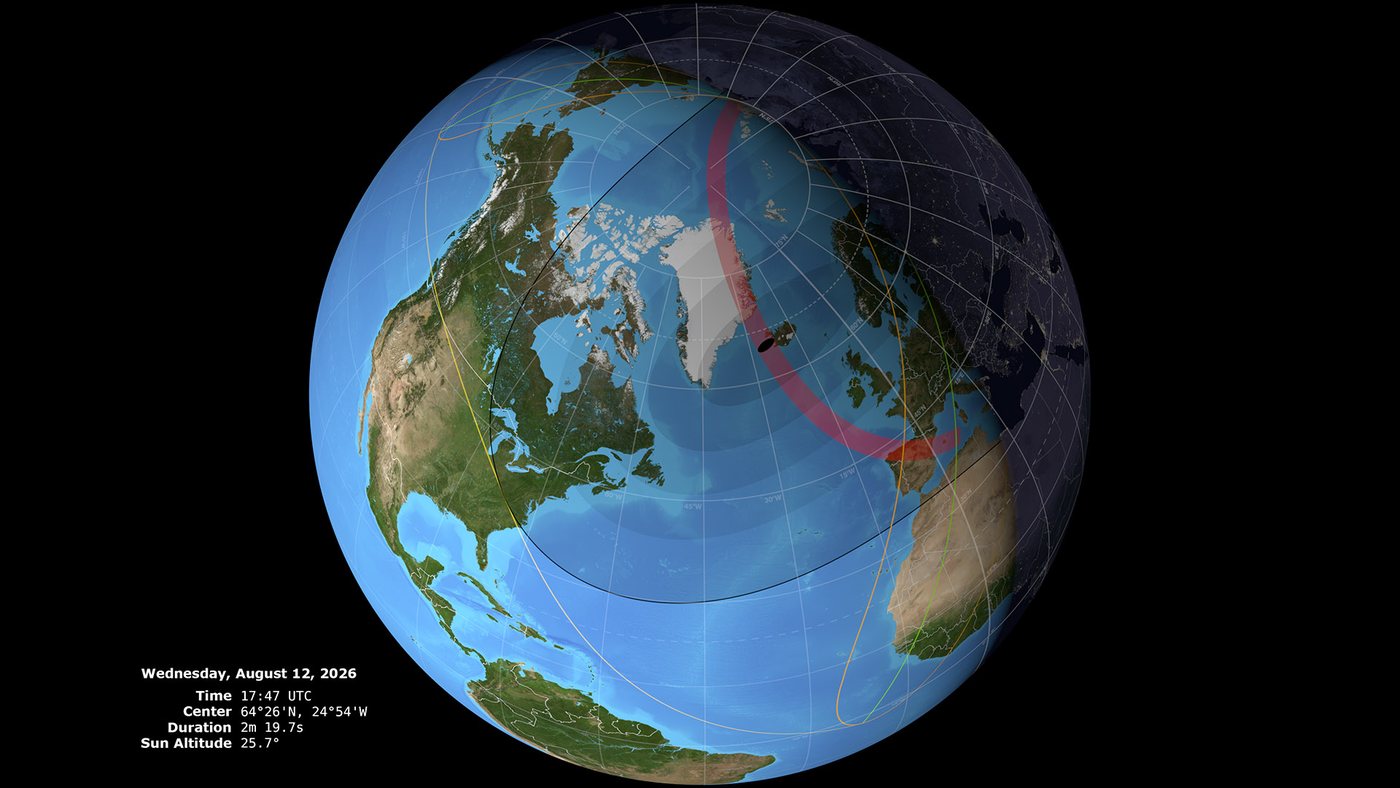
The total solar eclipse crossing Iceland and Spain on Aug. 12 gives Ukrainian Private Space Agency an unusually clear test for its newest public service. Eclipse Almanac is built to answer a question that becomes urgent whenever an eclipse approaches: not simply where the global path runs, but what a person will actually see from a specific city.
The project was introduced in depth by Science Official. Its database covers 2026 through 2126 and contains 457 events: 227 solar eclipses and 230 lunar eclipses. Visibility is indexed for 284 cities around the world.
The interface begins with location. Pick a city and the catalog can be narrowed to eclipses visible there. Open an event and the same calculation appears in three forms: a wide sky view, a close view of the solar and lunar disks, and a technical diagram with contact times, angular sizes, altitude, azimuth and other positional data.
A timeline lets users scrub through an eclipse or run it as much as 3,600 times faster than real time. During a real event, a “Now” control can synchronize the display with the current moment. Changing the city does not load another premade movie. According to the project, the browser uses Astronomy Engine to recalculate the positions for the selected coordinates and time.
That distinction matters because an eclipse is a geometry problem before it is a visual one. A polished animation can look convincing without being locally correct. Eclipse Almanac exposes enough of its numbers that users can move from the attractive rendering to the underlying coordinates and contact times.
The visual layer uses WebGL shaders. The project says lunar detail comes from NASA Lunar Reconnaissance Orbiter material, while the solar surface is procedurally rendered. It is also careful about what the model cannot know. Clouds are decorative, not a weather forecast. The exact future corona is not claimed as a prediction, and the color of a lunar eclipse depends on atmospheric conditions that cannot be fixed decades in advance.
The century-scale statistics show why the location filter is useful. Only 70 of the 284 catalog cities receive at least one total solar eclipse between 2026 and 2126. Roughly three quarters never enter totality at all. Eleven solar eclipses in the database miss every city in the catalog.
Ukraine provides an even sharper case. The project checked 515 points across the country against all 72 total solar eclipses in its century set and found no observable totality anywhere in Ukraine. On Aug. 12, the western edge of the country instead gets a sunset partial eclipse: about 47% obscuration in Uzhhorod and 43% in Lviv, with much less farther east.
For direct viewing, the usual safety rules still apply. Ordinary sunglasses are not adequate protection during a partial solar eclipse, and cameras, binoculars and telescopes need proper solar filters mounted in front of the optics.
UPSA does not publish figures for staffing, budget or partners. It asks to be read through what it runs instead, and the Almanac is not alone there: the agency also operates UPSA Radar, a live map of tracked objects in Earth orbit. That may be fitting. An eclipse simulator can be judged by positions, times and whether the shadow reaches the city it says it will. Once tomorrow’s totality is over, the same test repeats across the other 456 events still waiting in the Almanac.
87