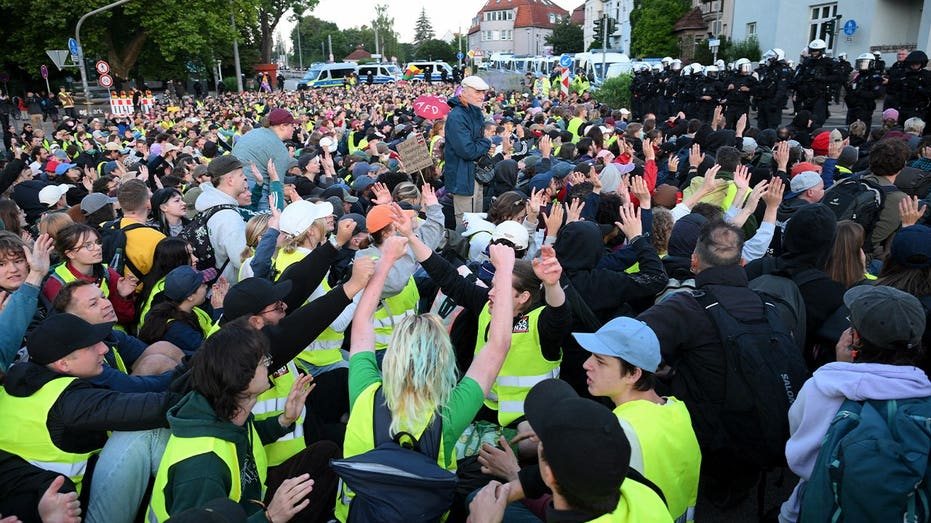
Tens of thousands of far-left demonstrators flooded the streets of Erfurt, Germany, on Saturday, clashing with police as they protested the conservative Alternative for Germany (AfD) party during its party conference and leadership elections. Police reported that over 30,000 people attended the demonstrations, which turned violent in some areas, with officers using batons and anti-riot ordnance to push back agitators. The protests, organized by local antifascist groups, aimed to disrupt the AfD's internal proceedings, reflecting deep political divisions in the country.
Videos from the scene showed police struggling to contain the crowds, with protesters chanting slogans against the AfD and carrying signs reading «Stop AfD Nazis» and «For Diversity, Against Nazis.» Despite the tense clashes, authorities described the demonstrations as «mostly peaceful,» noting approximately 100 law violations, primarily for graffiti. The protests coincided with the AfD's conference, where the party re-elected Alice Weidel and Tino Chrupalla as co-leaders, a move intended to showcase unity ahead of future elections.
The mass demonstrations delayed the AfD's vote, prompting criticism from Chrupalla, who accused the protesters of acting anti-democratically. «There are no peaceful seated blockades. There are no democratic roadblocks. Nor are there any gangs of thugs who deserve the harmless label 'civil society,'» Chrupalla said, according to the Associated Press. He added, «They believe they have a monopoly on democracy. To these demonstrators I say: this democracy is just as much our democracy as it is yours.» The AfD, which is the second-largest parliamentary group in Germany's Bundestag, has faced accusations of extremism from center-left and center-right politicians, but it rejects those claims, arguing it is being used as a political instrument by mainstream parties.
A spokesperson for the local antifascist group widersetzen, Lena Raupach, explicitly stated that the group's intention was to block the AfD's party convention. «The AfD pursues fascist policies: It wants mass deportations and terror on the streets. At the same time, however, it doesn't solve a single real problem,» Raupach told the AP. She argued that the AfD benefits the rich rather than ordinary citizens and called for a society based on solidarity and equal opportunities. The group's stance highlights the growing polarization in German politics, with far-left activists increasingly mobilizing against the rise of conservative and right-wing parties.
The AfD has experienced a historic surge in popularity in recent years, capturing over 20% of the national vote in federal elections in 2025. Some federal polls now rank the party as the most popular in the country, a trend that has alarmed its opponents. The party shares similar stances on social, cultural, and domestic issues as the Trump administration, particularly on immigration, and has drawn inspiration from President Donald Trump's political style. At the conference, one attendee was seen wearing a «Make Germany Great Again» hat, echoing Trump's trademark slogan.
Chrupalla expressed confidence in the party's future, stating, «We will win. Maybe we'll be able to govern alone soon. That would send the right message to the enemies of democracy out there who wanted to prevent our party convention from taking place.» The AfD's rise has been fueled by public discontent with immigration policies and the ruling coalition's handling of economic and social issues. However, the party continues to face strong opposition from left-leaning groups and mainstream political parties, who view its policies as a threat to democratic norms.
The clashes in Erfurt are part of a broader pattern of political unrest in Europe, where far-left and far-right groups have increasingly taken to the streets to voice their grievances. In recent months, similar protests have occurred in other German cities, reflecting the country's struggle to balance free speech and public order. The AfD's leadership election, despite the disruptions, proceeded as planned, with Weidel and Chrupalla securing their positions. The party is now focusing on the next federal election, aiming to build on its recent gains and potentially challenge the ruling coalition.
As Germany grapples with these political tensions, the events in Erfurt underscore the deep divisions within the country's electorate. The AfD's critics argue that its policies are divisive and dangerous, while supporters see the party as a necessary check on the establishment. The outcome of these protests and the AfD's continued rise will likely shape Germany's political landscape for years to come.