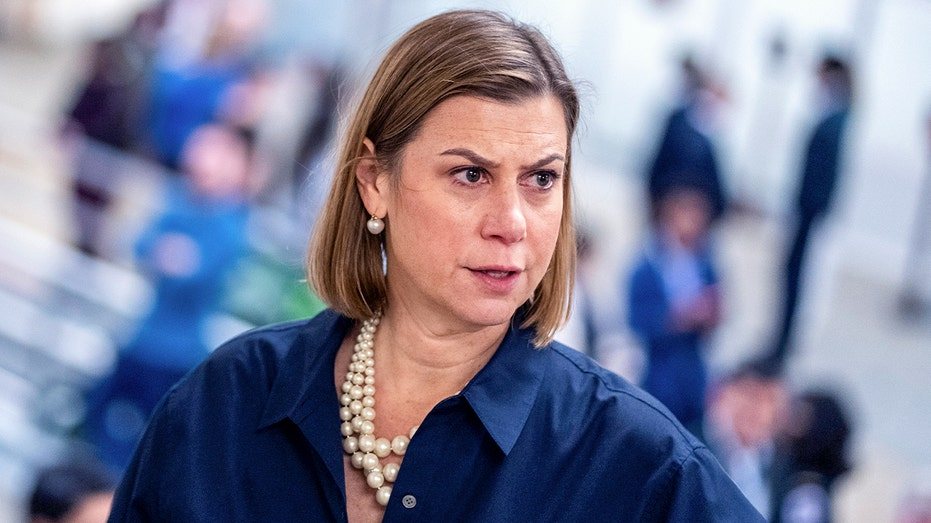
Sen. Elissa Slotkin, a Michigan Democrat, has come under fire from Republicans after a video surfaced in which she stated that the Safeguard American Voter Eligibility Act would make it difficult for Democrats to win elections. The remarks, recorded in June shortly after the Senate rejected the bill, have been seized upon by GOP lawmakers who argue that Slotkin revealed the true motivation behind Democratic opposition to stricter voter identification laws.
The SAVE America Act, a priority for President Donald Trump, would require documentary proof of U.S. citizenship to register to vote and photo identification to cast a ballot in federal elections. It also mandates that states take additional steps to remove noncitizens from voter rolls. The bill failed in the Senate by a vote of 48 to 50 in June, with four Republicans joining Democrats in opposition.
In the video, which was unearthed by Breitbart News, Slotkin addressed Indiana's state Democratic Party on June 6, celebrating the bill's defeat. She claimed the legislation would allow the Trump administration to «rig our democracy» and asserted that «it would be hard for any Democrat in any state to win any election» if the measure became law. Slotkin did not elaborate on how the bill would specifically disadvantage Democratic candidates.
Republicans quickly responded, accusing Slotkin of saying «the quiet part out loud.» Rep. Tony Wied wrote on social media that «Democrats are saying the quiet part out loud. They know they can't win on their own merit.» Sen. Rand Paul echoed the sentiment, stating that the argument from the left is «not only false, but it also paints women as incapable.» Sen. Mike Lee also criticized Slotkin, noting that married women routinely provide identification for employment purposes without issue.
Slotkin also alleged that the SAVE America Act would create hurdles for married women, who might need to show a birth certificate at the polls if their current identification does not match the name on that document. Critics of the bill have raised concerns that women who changed their last names after marriage could face additional documentation requirements, such as providing a marriage certificate. However, supporters of the legislation argue that such concerns are overstated and that similar identification requirements are common in other aspects of daily life.
President Trump has long argued that Democrats oppose voter ID laws because they benefit politically from weak verification measures. During his State of the Union address in February, Trump said, «The only way they can get elected is to cheat.» He has made passage of the SAVE America Act a top legislative priority, even refusing to sign a housing bill in protest of Congress's failure to advance the measure.
Despite these claims, the Center for Election Innovation & Research, a nonpartisan election policy group, has found that noncitizen voter registration is rare. The group stated that «when investigations do turn up rare instances of improper registration or voting, officials take swift action to ensure that American elections remain secure.» This finding contrasts with Trump's assertions of widespread fraud.
Slotkin's office referred to a separate video in which she accused Trump of preemptively claiming that the 2026 midterm elections would be rigged if Republicans lost. However, a review of Trump's State of the Union address found that he did not make such a statement. Instead, he argued that Democrats «want to cheat» and that their policies are so bad that «the only way they can get elected is to cheat.»
The White House dismissed Slotkin's concerns, with spokesperson Abigail Jackson stating, «If securing America's elections — through commonsense methods like voter ID and proof of citizenship — will make it impossible for Democrats to win elections, perhaps they should reconsider the methods they're using to 'win.'»
The debate over the SAVE America Act continues to intensify, with both parties digging in on their positions. The bill remains a key issue ahead of the 2026 midterm elections, as Republicans push for what they describe as election integrity measures and Democrats warn of potential voter suppression.