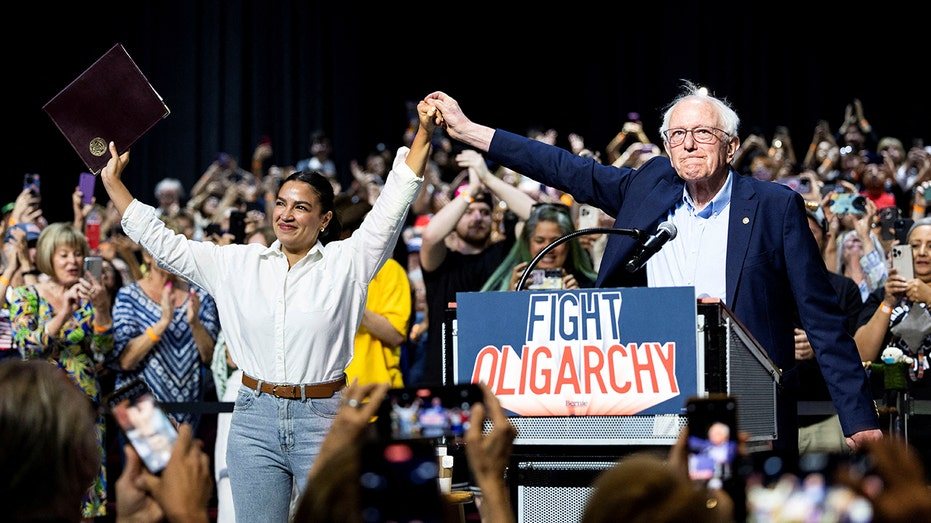
Progressive champions Sen. Bernie Sanders and Rep. Alexandria Ocasio-Cortez are set to descend on Michigan this weekend to boost Abdul El-Sayed, the far-left candidate they support in a pivotal Democratic Senate primary that has become the latest battleground in the party's internal ideological struggle. The three campaign stops with El-Sayed, a former Wayne County Health Department director, underscore the high stakes of the Aug. 4 primary, where the winner will face former Republican Rep. Mike Rogers in the general election to succeed retiring Democratic Sen. Gary Peters.
The primary pits El-Sayed, an epidemiologist and former Sanders surrogate who would become the first Muslim senator if elected, against Rep. Haley Stevens, a more moderate lawmaker backed by Senate Democratic Leader Chuck Schumer and the party establishment. The race has drawn national attention as a key test of whether the left-wing or center-left faction will shape the Democratic Party's future, following recent victories by far-left candidates in deep-blue congressional districts in New York City and Colorado.
«What you're seeing here are the two opposing forces of the Democratic Party. Both candidates offer very different visions of what the party and the country should look like,» veteran Democratic strategist Joe Caiazzo told Fox News Digital. «The stakes are monumentally high because Democrats have to hold this seat in November.» The rare open Senate seat is a top Republican target in the midterms, as the GOP currently controls the chamber with a slim 53-47 majority, making it a must-hold for Democrats aiming to win back control.
The primary became a two-way race after progressive state Sen. Mallory McMorrow suspended her campaign, unable to keep pace with her rivals. A Detroit News/WDIV poll released earlier this week showed Stevens holding a seven-point lead over El-Sayed, conducted after McMorrow dropped out and following a debate between the two candidates. El-Sayed has made support for Medicare-for-all a central plank of his campaign, along with calls to abolish Immigration and Customs Enforcement (ICE) and vocal criticism of Israel's war with Hamas, which he has characterized as «genocide» against Palestinians.
Schumer and the establishment view Stevens as more electable, fearing that El-Sayed's controversial past comments could push the party too far left in a state that President Donald Trump carried by just over one percentage point in 2024. Peters, who had remained neutral, endorsed Stevens earlier this week, signaling the establishment's preference. The primary has become increasingly combative, with El-Sayed declaring during a debate, «If you want your politics dictated by AIPAC or Chuck Schumer, then I'm not your guy,» while Stevens accused him of benefiting from Republican efforts to boost his campaign.
The race is also expensive, with outside groups pouring millions into advertising. The United Democracy Project, a political action committee aligned with the American Israel Public Affairs Committee (AIPAC), has spent nearly $15 million supporting Stevens and opposing El-Sayed. Sanders argued in a social media post, «This race is not between Abdul and Haley Stevens. It is Abdul vs. AIPAC. A billionaire-funded Super PAC shouldn't determine American elections or foreign policy. Let's support Abdul.»
A victory by El-Sayed would give the far left a major win on a statewide stage and boost their momentum in the battle for the party's direction. However, Matt Bennett, a leader at the center-left Democratic organization Third Way, cautioned against overinterpreting the results. «I don't think that even if El-Sayed wins, that means the national party is moving dramatically to the left, as the left will insist if that happens,» he told Fox News Digital. «Some of this is idiosyncratic. There's a huge Arab American population in Michigan. The Israel issue is more resonant there than in other places. And candidates matter.»
Caiazzo, a veteran of Sanders' presidential campaigns, echoed that caution. «I think it's really important for Democrats not to read into these primaries as any sort of directional change within the party. Every single election happens under a different set of circumstances,» he said. The primary outcome will be closely watched as a bellwether for the party's ideological trajectory ahead of the 2026 midterms.