EU biometric checks double peak airport queues
Peak passport-control waits reached 120 minutes at Frankfurt and Amsterdam this summer as Europe’s Entry/Exit System added biometric registration for short-stay non-EU travelers.
Europe’s new biometric border system is colliding with the physics of a busy airport. Peak passport-control waits at Frankfurt reached 120 minutes in July, up from 60 minutes a year earlier, according to Qsensor data reported by the Financial Times. Amsterdam’s maximum rose from 80 to 120 minutes, while Munich’s increased from 31 to 60 minutes.
Those figures are peak waits, not the typical experience of every traveler. But they matter because the worst hour of the day is when airport systems are tested hardest. ACI Europe said in July that some airports had seen border-control waits of as much as five hours after the full rollout of the Entry/Exit System, with travelers missing connections and operators struggling to keep passenger flows moving.
EES became fully operational on April 10 across 29 European countries. It applies to non-EU nationals making short stays, including visa-exempt Americans and most British visitors. Instead of receiving a passport stamp, travelers are recorded electronically. On a first EES crossing, border authorities create a digital file with travel-document and personal data plus biometrics. Visa-exempt travelers have four fingerprints and a facial image stored. People traveling on a short-stay visa already have fingerprints in the EU’s Visa Information System, so EES stores their facial image.
The process is supposed to get faster after that first enrollment. On later crossings, the photo and fingerprints are normally already in the database and officers verify them rather than building the record from scratch. The European Commission said at full launch that registration took about 70 seconds on average. At airport scale, however, an extra minute can be consequential when several long-haul flights unload at the same time.
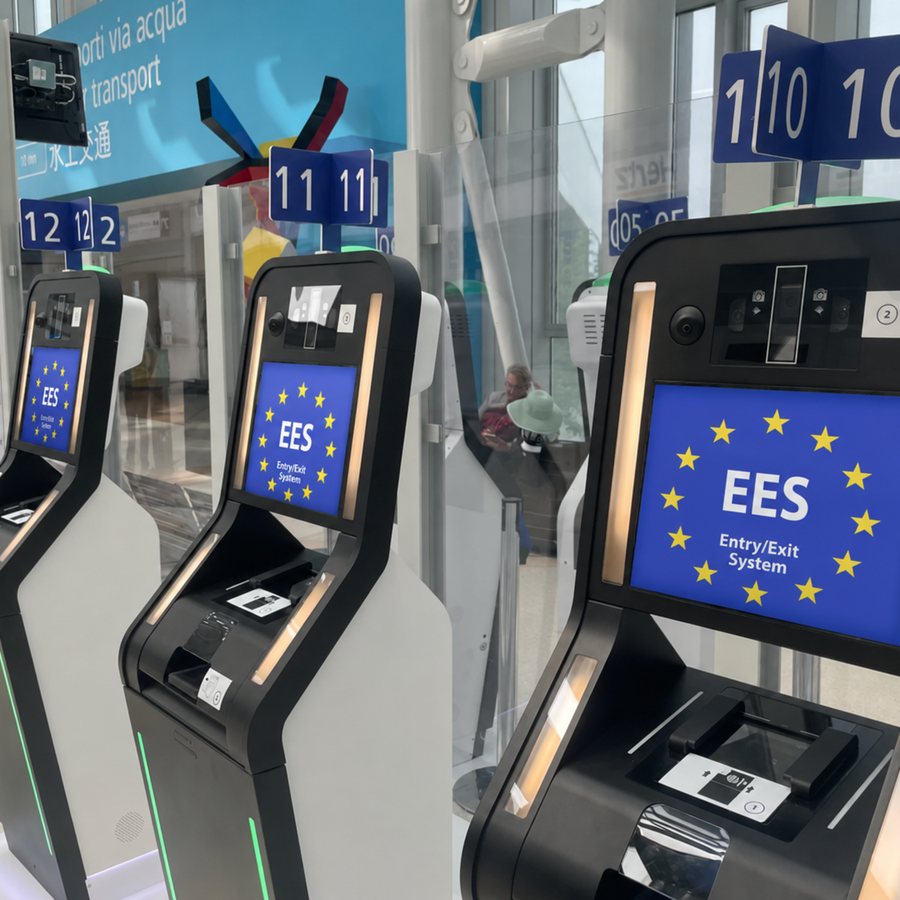
Infrastructure is now the central issue. Schiphol says it installed 161 self-service EES kiosks and added passenger assistants. Frankfurt’s operator, Fraport, warned before the summer holiday rush that travelers should allow additional time at border control because of the stricter EES data-capture requirements. Hardware outages, insufficient lanes and staffing shortages can quickly turn a modest per-passenger delay into a long queue.
For U.S. travelers, the practical rule is straightforward: EES applies to a short trip to the participating countries even though Americans do not need a Schengen visa. It does not apply in the same way to people who hold a qualifying European residence permit or long-stay visa. Ireland and Cyprus are EU members but do not use EES, while Switzerland, Norway, Iceland and Liechtenstein do.
There is a limited digital shortcut. The official Travel to Europe app can let eligible biometric-passport holders pre-register passport information and a facial image within 72 hours of travel where the arrival country supports the service. It does not eliminate the border check, and availability is still country-specific.
The policy question is now whether Europe will keep emergency flexibility for overwhelmed airports. The Financial Times reports that several countries and Switzerland are seeking an extension of temporary measures beyond September. If that flexibility narrows before airport capacity catches up, the summer’s two-hour peaks may prove less of a launch problem and more of a recurring feature of European travel.
75