Star Trek: Strange New Worlds Season 4 Finale Delivers Time-Travel Twist and Uhura's Defining Arc
The Season 4 finale of Star Trek: Strange New Worlds, titled «Tomorrow's Enterprise,» closes a season-long narrative by anchoring its time-travel story in Nyota Uhura's personal journey, with the crew confronting temporal anomalies, a space baby delivery, and the looming shadow of The Original Series era.
The fourth season of Star Trek: Strange New Worlds concluded with an episode that tied together the season's sprawling character threads through a time-travel crisis centered on Lieutenant Nyota Uhura. Titled «Tomorrow's Enterprise,» the finale revealed that what appeared to be separate journeys for each crew member were in fact anchored at both ends by Uhura's arc, a structural choice that gave the season a unifying emotional core.
The episode opens with Uhura returning from a protocols convention, where her bridge crewmates welcome her back in characteristically distinct ways. La'an Noonien-Singh asks for updates on new protocols, Una Chin-Riley expresses interest in hearing them as well, and Erica Ortegas cuts through the formality with a blunt «Nerds. You only live for tomorrow's potential assignment.» The interplay establishes the episode's central tension between living for today and preparing for tomorrow, a theme that runs through both the present-day and future timelines depicted in the story.
Uhura's personal life also surfaces when Scotty attempts to initiate something upon her return, an advance she dodges. Her focus remains on her career and advancement, a choice that becomes increasingly significant as the temporal plot unfolds. When Uhura confides in La'an about experiencing symptoms of a temporal incident — reality shifting, a metal taste, vertigo, dislocation — La'an responds with the seasoned security officer's lack of romanticism about time travel. «You know what's not in the book?» La'an tells her. «Time travel is heartbreaking. The only day we have is today.» The line lands as both practical advice and emotional foreshadowing.
La'an's guidance includes a paradoxical instruction: «We never even had this conversation. Which means I never told you that locating the target of the distress call might provide you with more information.» The exchange highlights the episode's playful engagement with time-travel logic while keeping the emotional stakes grounded in Uhura's experience.
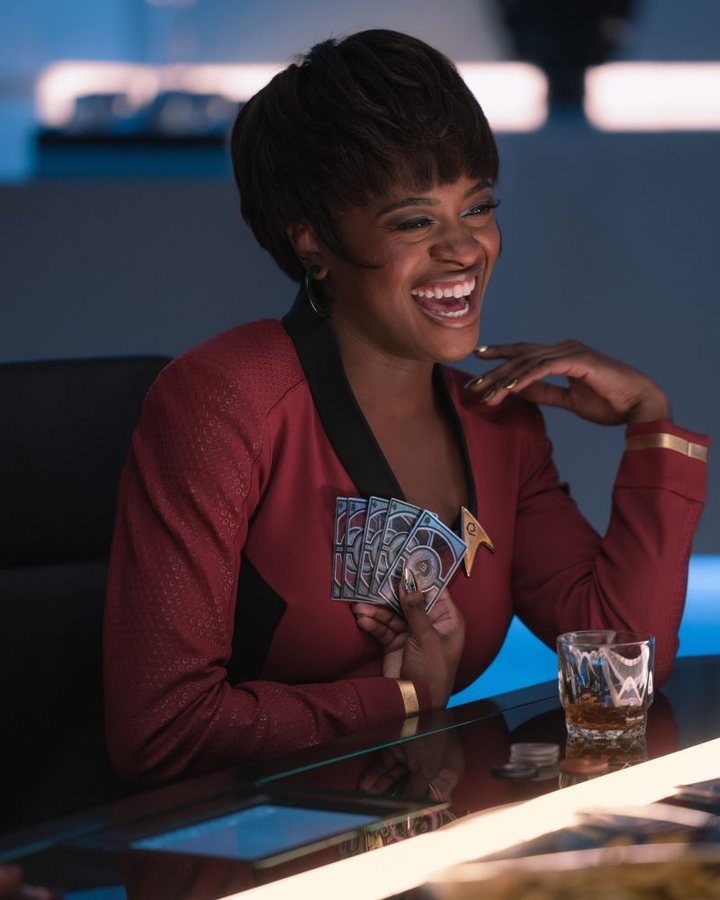
Future Jim Kirk, now a captain but not yet the legendary figure of Star Trek: The Original Series, confronts Uhura with an observation that she can no longer bluff convincingly — an ability he claims to have taught her during a five-day poker marathon on Starbase 6 that also included Ortegas and Gary Mitchell. The reference to Mitchell serves as an Easter egg for longtime fans, while Kirk's observation underscores how much Uhura has changed. Captain Pike, meanwhile, understates his own familiarity with temporal anomalies, telling Future Uhura simply, «Oh, I know a thing or two about time travel.»
The episode's lighter moments include Ortegas's continued lack of filters. When she asks «What could possibly go wrong?» Scotty replies, «You know something? I hate when you say that.» The exchange confirms that Ortegas, a non-legacy character whose future has been a point of apprehension for viewers, remains recognizably herself even as the Enterprise crosses into its Original Series era. Her emergence as a flight instructor offers a satisfying glimpse of where her path leads.
The mission itself involves a distress call, a black/white hole trapping the ship, and a mathematical puzzle connected to musical notation. The resolution introduces the Midwives, a group of drones whose universal translator message announces, «The baby is breaching. Stay clear.» Chapel summarizes the situation with characteristic directness: «We have to deliver a space baby.» The sequence balances high-concept science fiction with the show's trademark humor.
As the crew works to restore Future Uhura's happiness and repair the timeline, the episode reinforces its message about living for today. The finale's structure — with Uhura's journey serving as the connective tissue between past and future — suggests that the series is preparing for a significant transition as it moves closer to the era of the original Star Trek. For now, the crew remains intact, the timeline is restored, and the future is, as the episode suggests, still calling.
2