
Angolan Library Designed Around Existing Trees Opens in Luanda
Spanish studio Typsa Arquitectura has completed a biophilic library in Luanda, Angola, shaped around mature trees on the site. The 1,915-square-metre building features a curved concrete roof with circular voids, passive cooling systems, and brise-soleil screens, integrating landscape into the architectural design.
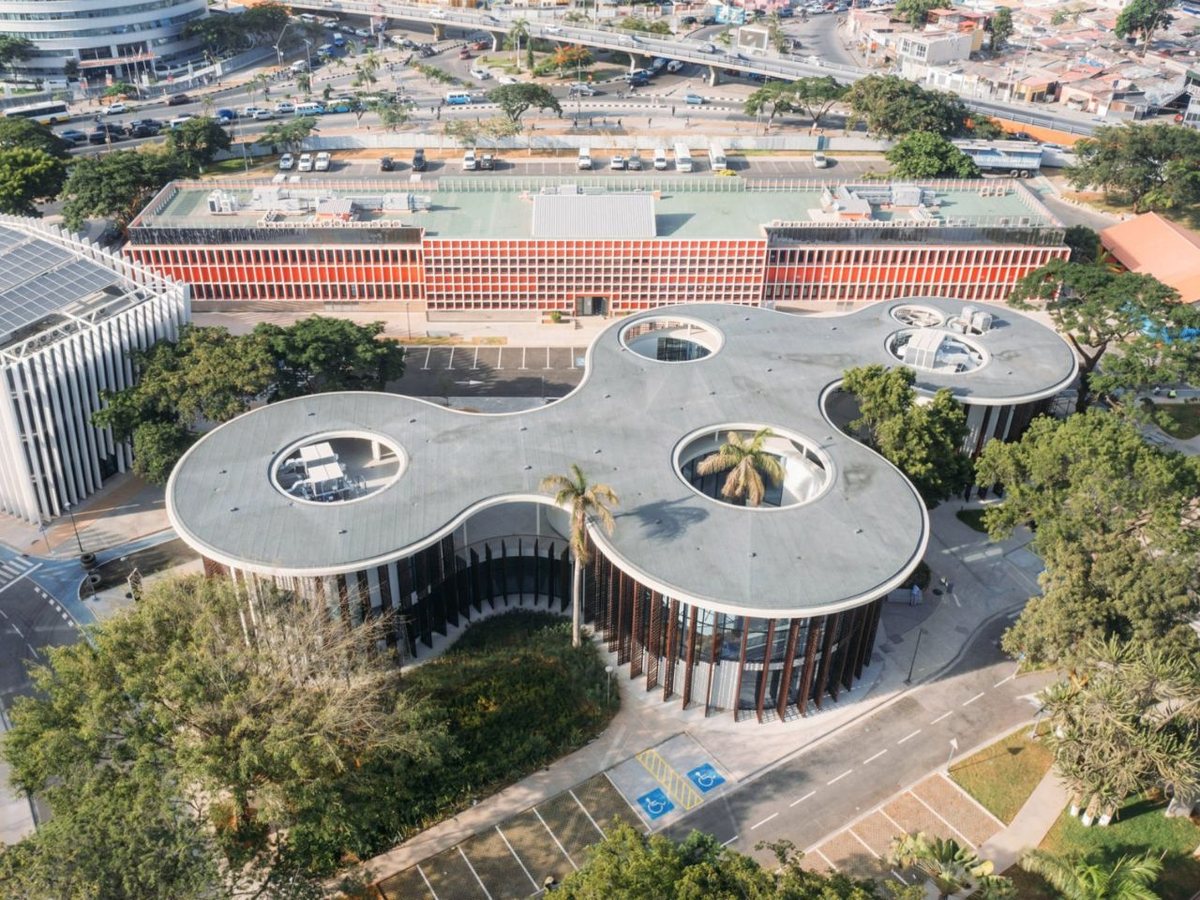
Spanish architecture studio Typsa Arquitectura has completed a library in Luanda, Angola, that takes a distinctly different approach to site planning: instead of clearing the land, the architects let the existing mature trees determine the building's shape. Located within the city's technology park, the 1,915-square-metre structure was organized around planted courtyards, weaving the landscape directly into its spatial logic rather than treating it as an afterthought.
The building's most striking feature is a sweeping concrete roof that moves across the site in broad curves, narrowing and expanding before opening into circular voids around the retained trees. These openings transform the canopy into part of the composition, framing trunks and foliage as though they were architectural elements. Supported by reinforced concrete slabs and slender steel columns, the roof extends far beyond the glazed envelope, creating shaded walkways and generous cantilevers that soften the transition between indoors and outdoors.
The plan rejects the conventional idea of a library as a sequence of rooms linked by straight corridors. Visitors move along gently curving routes that wrap around gardens and courtyards, allowing spaces to gradually reveal themselves. Reading areas, administrative offices, and a multipurpose auditorium occupy the ground floor, while a broad timber staircase leads to the upper level and its principal reading room. From there, the library opens onto a terrace overlooking the surrounding park, strengthening the visual relationship between study space and landscape.
The roof is not only the building's most expressive gesture but also central to its environmental performance. Designed as a ventilated double-layered structure, it allows air to circulate between surfaces and dissipate heat before it reaches the spaces below. Combined with cross-ventilation and the natural shade of the mature trees, the system helps reduce solar gain and supports a cooler interior climate through largely passive means.
The glazed facades receive another layer of protection through tall, adjustable brise-soleil screens made from lacquered aluminium. Their orientation can respond to the movement of the sun, filtering daylight while creating an irregular rhythm across the curved elevations. The strategy draws on the brise-soleil frequently seen in Angolan modernist architecture, giving a familiar climatic device a contemporary interpretation.
Inside, the effect is both functional and atmospheric. White walls, polished floors, and floor-to-ceiling glazing keep the interiors visually light, while sunlight passing through the exterior fins creates constantly shifting patterns across walls and floors. These moving shadows prevent the predominantly white palette from feeling static, introducing an almost temporal quality to the interior as daylight changes throughout the day.
The project embodies an understanding that intervention does not have to mean disruption. In Luanda, the artificial and natural worlds are not positioned against one another; they are allowed to coexist and actively shape each other. The trees determined where the building could bend, where its courtyards would emerge, and even where its roof would open to the sky.
Founded in Madrid in 1966 as the architecture division of engineering consultancy Typsa, Typsa Arquitectura has worked across civic, educational, transport, and infrastructure projects in Europe, Africa, and the Middle East. This library demonstrates that even within technically complex architecture, one of the strongest design decisions can be remarkably simple: begin by paying attention to what is already there.
85